- What “Audience Signals” Actually Mean
- Where YouTube “Pushes” Videos (And Why That Matters)
- The Signals YouTube Actually Reads
- Audience Signals That Matter (With Real-Life Meaning)
- How YouTube Decides to Expand Reach (A Practical Example)
- The Performance Signals That Decide “Scale or Stall”
- The Overlooked Signal: Context
- How to Engineer Better Audience Signals (What You Control)
- How Platforms Like Reachism can help?
- Final Takeaway
YouTube doesn’t “push” videos randomly. It recommends videos to specific viewers when its system predicts based on audience signals that those viewers will click, watch, and feel satisfied. If the video performs well with that group, YouTube expands distribution to similar people.
What “Audience Signals” Actually Mean
YouTube’s recommendation system is designed to show the most relevant video to each individual viewer at a specific moment, while maximizing long-term viewer satisfaction.🔗 YouTube Official Blog
Importantly, YouTube does not follow a fixed checklist for creators.
It learns from audience signals what people:
choose to watch
ignore
engage with
actively rate
In everyday terms, YouTube behaves like a friend who learns your taste over time.
If you always finish spicy fries but abandon sweet desserts halfway, your friend will recommend more fries and fewer desserts. YouTube works the same way learning from patterns of behavior, not creator intentions.
Where YouTube “Pushes” Videos (And Why That Matters)
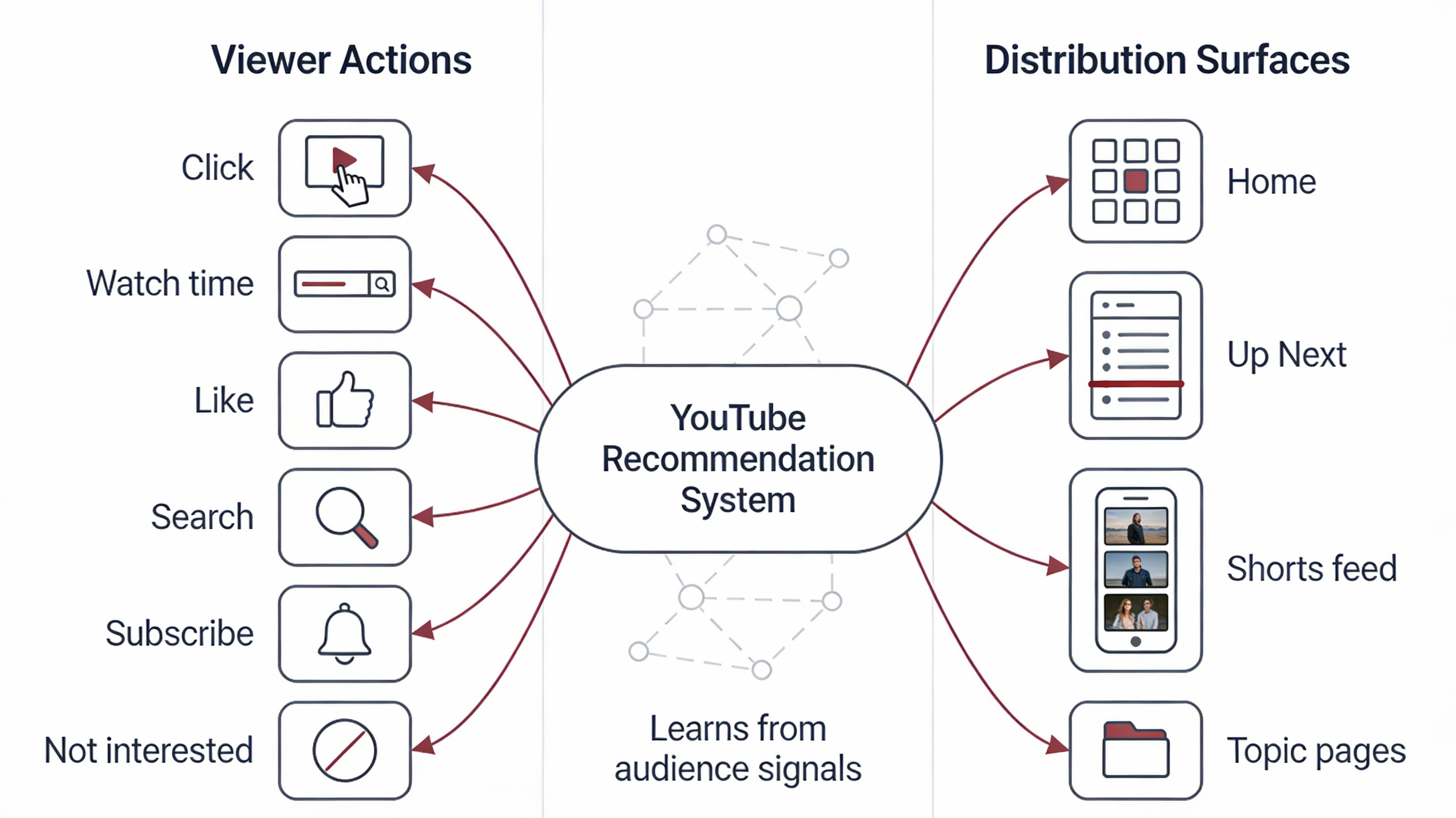
Recommendations appear across several surfaces:
Home page
Up Next / Suggested
Shorts feed
Destination pages (e.g., Music)
Parts of channel pages
These surfaces do not weigh signals the same way.
For example:
Up Next relies heavily on what the viewer is watching right now
Home relies primarily on long-term watch history
So when creators say, “My video got pushed,” what usually happened is that the video began appearing more frequently on one or more of these surfaces for viewers whose behavior matched earlier positive signals.
The Signals YouTube Actually Reads
YouTube explains that it compares each viewer’s habits with those of similar viewers, learning from a large set of signals, including:
Watch history
Search history
Subscriptions
Likes and dislikes
“Not interested”
“Don’t recommend channel”
Satisfaction surveys
YouTube groups these into two major buckets:
1. Viewer Personalization
Who the viewer is and what they usually like.
2. Content Performance
How the video behaves when offered to people:
Do they click?
Do they keep watching?
Do they engage positively?
YouTube also evaluates context in real time device, time of day, recent activity which explains why the same video can explode for one audience segment and remain quiet for another. 🔗 Indian Express Explainer
Audience Signals That Matter (With Real-Life Meaning)
Signal YouTube Uses | What It’s Really Saying | What to Do as a Creator |
|---|---|---|
Watch history | “This person repeatedly chooses content like this.” | Build series and recurring formats so each video fits prior habits. |
Search history | “They’re actively trying to solve this right now.” | Align titles with real search intent: how-to, comparisons, fixes. |
Subscriptions | “They want more from this topic or creator.” | Deliver consistently on the promise of why people subscribed. |
Likes / dislikes | “I want more of this / less of this.” | Make clear points or outcomes avoid generic filler. |
‘Not interested’ | “This wasted my time.” | Match thumbnail/title to the first 30 seconds exactly. |
‘Don’t recommend channel’ | “Stop showing me this creator.” | Avoid repeated bait-and-switch packaging it compounds distrust. |
Satisfaction surveys | “This felt worth my time (or not).” | Design a clear payoff and a satisfying finish. |
A key nuance:
If someone doom-scrolls to the end of a video while feeling annoyed, watch time alone would misread that as success. This is why YouTube explicitly uses satisfaction surveys to correct the picture.
How YouTube Decides to Expand Reach (A Practical Example)
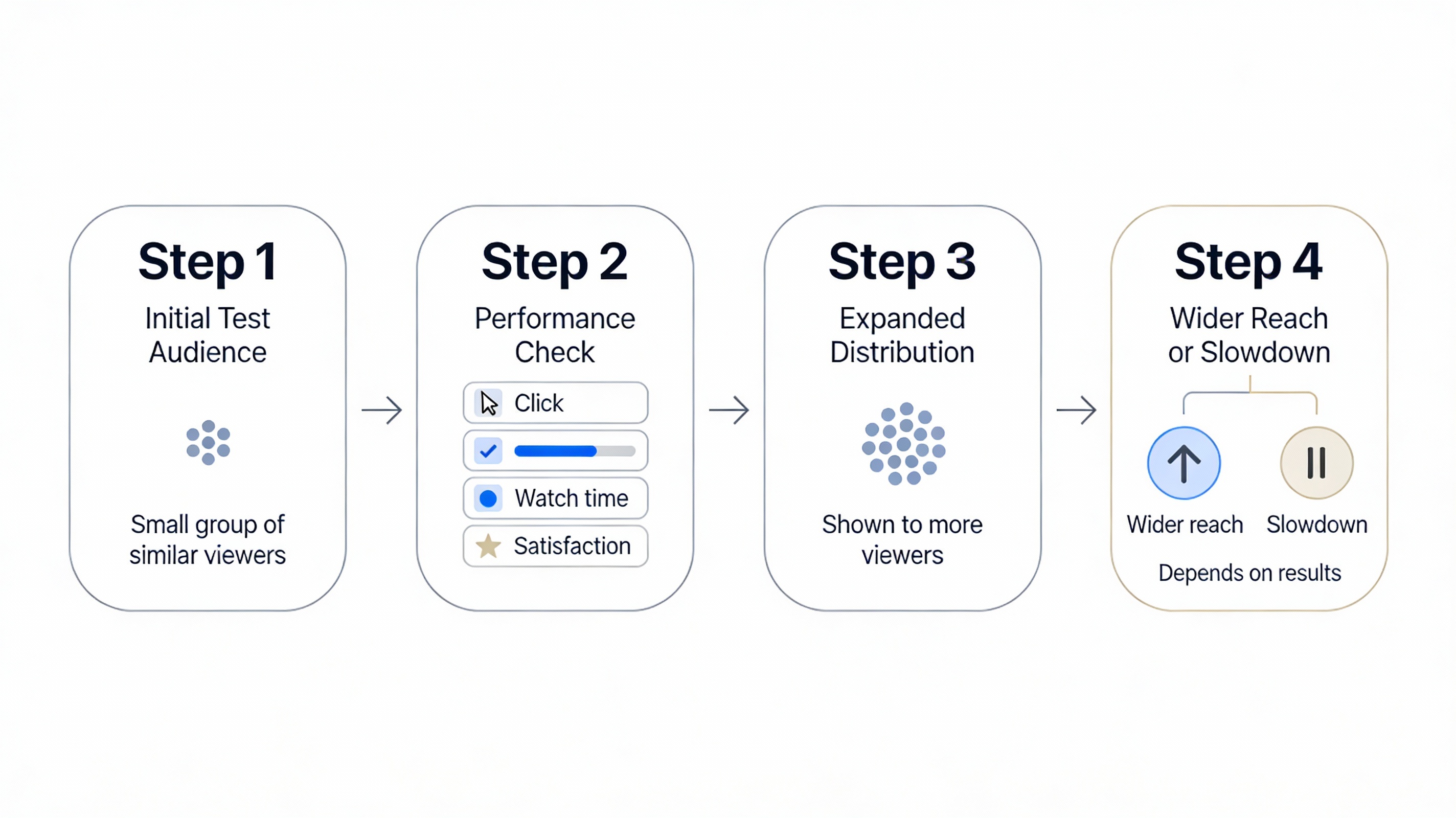
Think of YouTube distribution like launching a new item at a café.
First, it’s offered to regulars who usually order similar things.
If those people enjoy it, the café promotes it to more customers.
If they don’t, it quietly disappears.
This mirrors YouTube’s model:
Personalization determines who sees it first
Performance determines whether it scales.
The Performance Signals That Decide “Scale or Stall”
In practice, YouTube keeps asking:
“When we show this to people who should like it, do they actually choose it and do they feel it was worth their time?”
For creators, this maps to familiar metrics:
Click behavior (title + thumbnail alignment)
Ability to hold attention (early retention)
Positive or negative feedback
Satisfaction beyond watch time
The Overlooked Signal: Context
YouTube explicitly notes that recommendations are influenced by external factors:
Seasonality
News cycles
Device usage
Time-based habits
Example:
A home-workout video may spike every January and dip mid-year not because the video got worse, but because audience intent changed.
How to Engineer Better Audience Signals (What You Control)
These actions align directly with YouTube’s stated logic:
Packaging alignment: Title and thumbnail must accurately represent the payoff.
Front-load value: Confirm the click was a good decision in the first 30–60 seconds.
Single promise per video: One outcome, one payoff.
Session momentum: Point to a relevant next video to support continued viewing.
Series over singles: Consistent formats help personalization learn faster.
How Platforms Like Reachism can help?
Reachism can play a supporting role in early video distribution, not as a shortcut around YouTube’s system but as a way to create initial visibility. By helping a new upload reach a first wave of viewers, services like Reachism aim to generate early engagement signals such as clicks, watch time, and interaction.
Final Takeaway
YouTube doesn’t reward creators who chase the algorithm.
It rewards videos that real people choose, finish, and feel good about.
If you design content around:
Clear intent
Honest packaging
Strong retention
Genuine satisfaction
YouTube will do the distribution for you.