- How to Create TikTok Videos People Watch Twice
- Why Replays Matter More Than You Think
- The Core Principle: Controlled Incompleteness
- 5 Structural Tactics That Drive Replays
- 1. Fast Information Compression
- 2. The Loop Ending
- 3. Micro-Reveal Layering
- 4. Outcome First, Explanation Second
- 5. Perspective Shift
- How to Combine Them
- The Mistake Most Creators Make
- Replay Optimization Framework
- Performance Comparison: One-Watch vs Replay Content
- Final Insight
How to Create TikTok Videos People Watch Twice
Most creators optimize for views. High-growth creators optimize for replays.
A replay is stronger than a like. It tells the algorithm the content delivered value beyond passive consumption. On TikTok, replay rate silently boosts watch time, increases session depth, and strengthens distribution velocity.
If you want sustainable growth, you need to design videos that people instinctively watch again.
This is not about tricks. It is about structure.
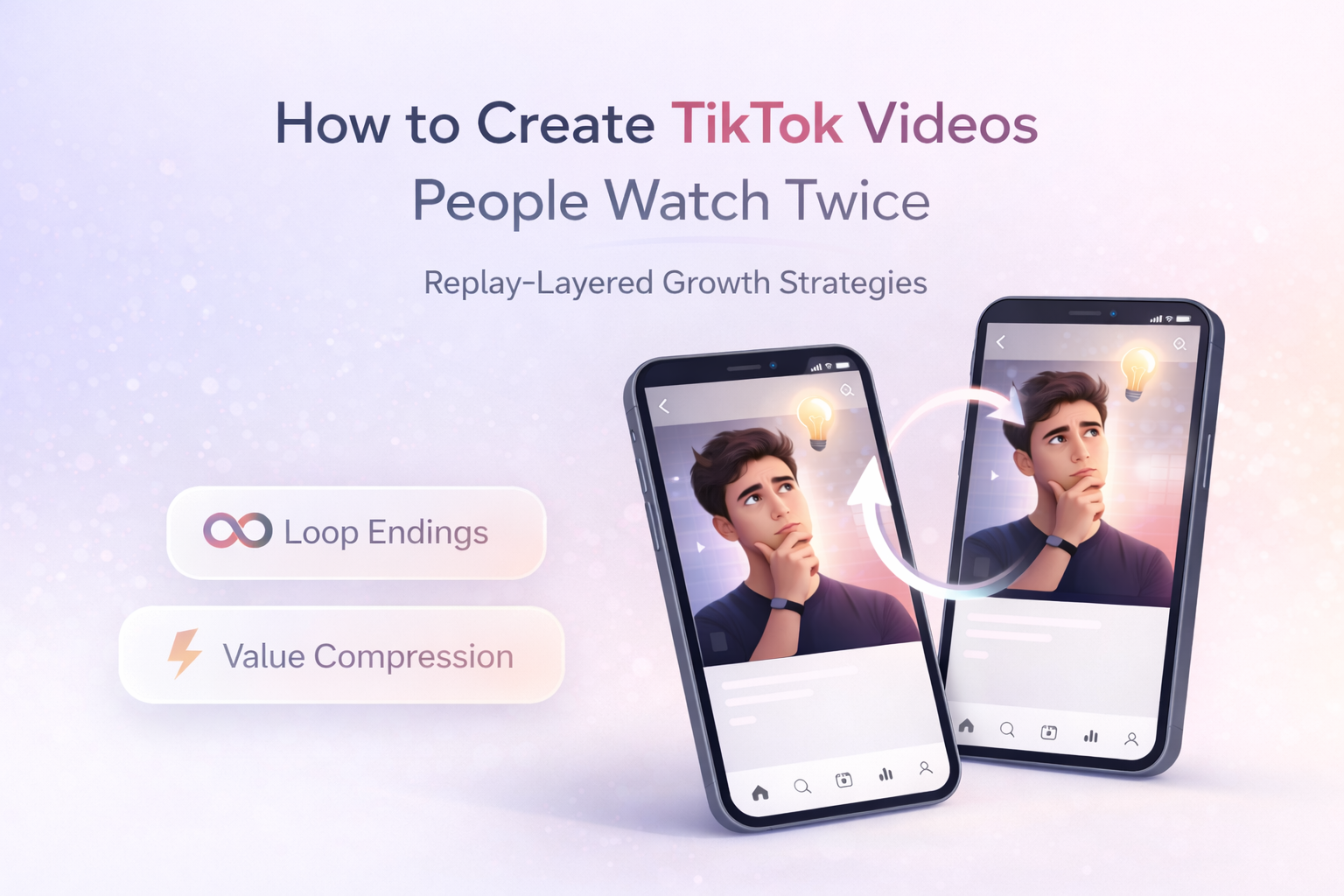
Why Replays Matter More Than You Think
TikTok’s recommendation system prioritizes watch time and completion rate, as outlined in TikTok’s official explanation of how recommendations work https://newsroom.tiktok.com/en-us/how-tiktok-recommends-videos-for-you.
When someone watches your video twice, three things happen:
Total watch time increases
Completion rate exceeds 100 percent
Engagement intent strengthens
That combination signals high value density.
Replays are rarely accidental. They are engineered.
The Core Principle: Controlled Incompleteness
People rewatch when their brain senses it missed something.
This is not manipulation. It is cognitive design.
Research on curiosity gaps summarized by Harvard Business Review explains that incomplete information increases engagement. When applied to TikTok, this translates into structured micro-tension.
If everything is obvious on first watch, there is no reason to replay.
If there is subtle compression, layered meaning, or fast sequencing, the viewer returns.
5 Structural Tactics That Drive Replays
1. Fast Information Compression
Structure: Deliver slightly more value than can be processed in one viewing.
Why it works:
When information density is high but still clear, viewers rewatch to absorb details they missed.
Universal Example
Video topic: “Why your content isn’t converting”
You say:
“Your content doesn’t convert because your hook attracts the wrong audience, your middle lacks tension, and your ending doesn’t give a reason to act.”
You deliver that in 6 seconds with light on-screen keywords:
Hook
Tension
Call to action
Most viewers catch the idea but rewatch to mentally break it down.
This works in any niche:
Fitness: “Your workouts plateau because intensity, progression, and recovery aren’t aligned.”
Study tips: “You forget information because you read, highlight, and move on.”
The compression creates replay.
2. The Loop Ending
Structure: Make the ending transition naturally into the beginning.
Why it works:
When the last line connects seamlessly to the first, the video feels incomplete without another viewing.
Universal Example
Opening:
“This is why your videos die at 200 views.”
Ending:
“And that’s exactly why your videos die at 200 views.”
When it loops, it feels intentional. Many viewers stay for a second pass without realizing it.
You can use this in:
Career advice
Marketing
Self-improvement
Tech tutorials
The content remains clear, but the structure encourages repetition.
3. Micro-Reveal Layering
Structure: Reveal something subtle on screen that supports the main message.
Why it works:
Viewers notice new details on the second watch.
Universal Example
You talk about “retention drop,” while a small graph behind you slowly declines.
First watch: they focus on what you say.
Second watch: they notice the visual.
Another example:
You say:
“Most creators focus on hooks.”
On-screen text appears quickly:
Hook ≠ Retention
Some viewers will rewatch to fully process the distinction.
This works across:
Business breakdowns
Finance explanations
Educational content
Even storytelling
Subtle visual reinforcement drives replays.
4. Outcome First, Explanation Second
Structure: State a strong result before explaining the mechanism.
Why it works:
The brain wants to resolve the “how.”
Universal Example
“This small change doubled my watch time.”
Pause.
“It wasn’t editing. It was restructuring the middle.”
Viewers rewatch to fully understand what the “middle restructuring” means.
You can adapt this everywhere:
“This habit doubled my productivity.”
“This tweak fixed my sleep.”
“This sentence increased my conversions.”
Reveal the outcome. Delay the mechanism. Deliver quickly.
That slight tension creates replay.
5. Perspective Shift
Structure: Reframe something people think they understand.
Why it works:
Reinterpretation makes viewers mentally re-evaluate.
Universal Example
“It’s not your content that’s weak. It’s your positioning.”
That line alone makes people reconsider everything they’ve posted.
Another example:
“It’s not your hook. It’s your transition.”
People rewatch to analyze their own transitions.
This works in:
Fitness: “It’s not your diet. It’s your consistency.”
Learning: “It’s not intelligence. It’s recall practice.”
Entrepreneurship: “It’s not traffic. It’s alignment.”
Perspective shifts drive replay because they challenge assumptions.
How to Combine Them
The strongest replay videos combine two tactics:
Example structure:
Outcome first
Compressed explanation
Loop ending
That layered design increases:
Watch time
Completion rate
Rewatch probability
Replays are not random. They are engineered through structure.
If you want growth that compounds instead of spikes, design your videos to reward the second viewing, not just survive the first.
Would you like me to turn this into a visual infographic-style framework you can reuse across your blog?
The Mistake Most Creators Make
Many try to force replay by making content confusing.
Confusion kills trust. Clarity drives replays.
The goal is layered clarity. The first watch should deliver value. The second watch should deepen it.
This is a structural difference between surface creators and system builders. Platforms like https://reachism.com/ focus on that deeper structural thinking, where every video reinforces positioning rather than chasing isolated spikes.
Replay Optimization Framework
Before posting, ask:
Is there a natural loop in the ending?
Is the pacing slightly compressed?
Does the video reward a second viewing?
Is there a subtle insight shift?
If the answer is yes, replay probability increases.
Replays compound distribution.
Performance Comparison: One-Watch vs Replay Content
Standard Video | Replay-Engineered Video |
|---|---|
Clear but linear | Circular or layered |
Single insight | Multi-layer insight |
Obvious pacing | Slight compression |
Ends cleanly | Ends into beginning |
Replay videos feel complete yet slightly unfinished at the same time.
That tension drives return behavior.
Final Insight
If people watch your TikTok twice, you are not just entertaining. You are increasing algorithmic confidence.
Replays boost watch time.
Watch time boosts distribution.
Distribution compounds growth.
Design for replay, not just reaction.
When your videos reward a second viewing, growth becomes structural, not accidental.