- What is the comment-to-content method?
- Why comments produce better ideas than brainstorming alone
- Which comments are worth turning into content?
- 1. Repeated questions
- 2. Objections
- 3. Confusion points
- 4. Strong emotional reactions
- 5. Audience success stories
- How to mine comments strategically
- Step 1: Review comments in batches
- Step 2: Sort comments into buckets
- Step 3: Promote recurring comments into content formats
- Step 4: Use the audience’s exact phrasing
- How to turn one comment into multiple content ideas
- Common mistakes that ruin the method
- Pro Tip
- Conclusion
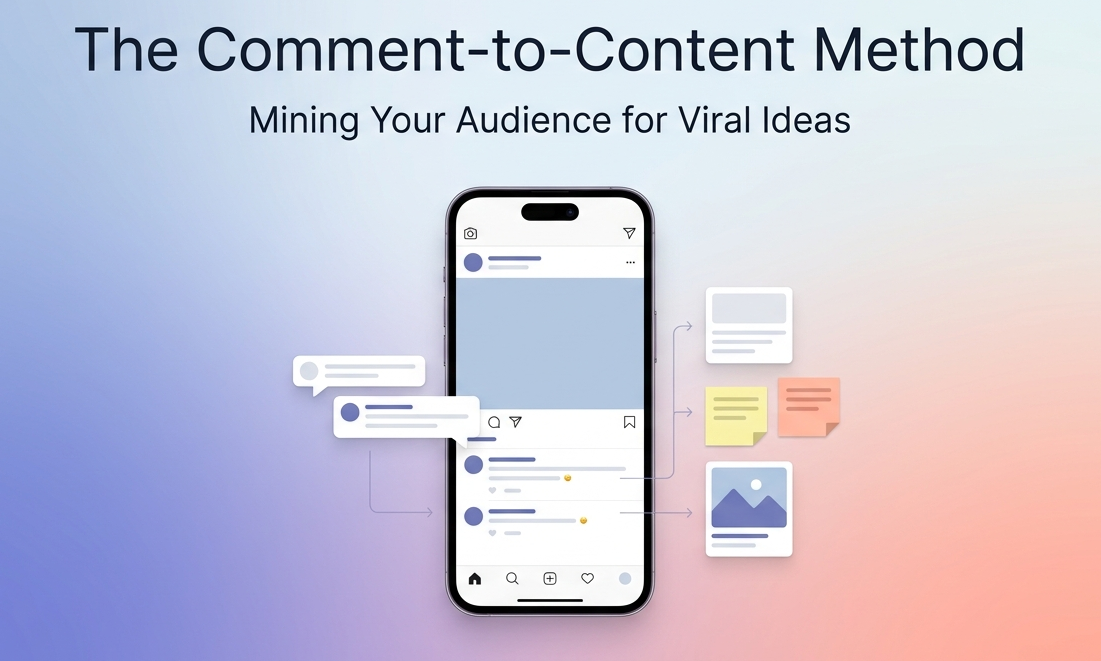
The comment-to-content method is one of the smartest ways to find viral ideas without guessing. Instead of brainstorming in isolation, you mine your audience for signals they are already sending through questions, objections, confusion, and strong reactions.
That matters because platforms reward relevance. TikTok says its recommendation systems personalize content based on user interactions, while Instagram’s creator guidance emphasizes meaningful engagement as a key distribution signal. When your next post is built from real audience conversation, it starts closer to proven interest than a random idea ever will.
If you want more consistent reach, better hooks, and stronger engagement, stop treating comments as leftovers. Treat them as research.
What is the comment-to-content method?
The comment-to-content method means turning audience responses into new content formats.
That includes:
direct questions
repeated misunderstandings
objections
hot takes
success stories
emotional reactions
requests for examples
debates in the thread
TikTok now explicitly offers comment insights inside TikTok Studio to help creators identify frequently discussed topics, audience suggestions, and questions from viewers for future content. YouTube has also highlighted comments as meaningful for creator feedback and future videos, and its newer Communities features are built around deeper creator-fan conversation.
In other words, the platforms themselves are telling you that comments are not just engagement. They are content intelligence.
Why comments produce better ideas than brainstorming alone
Most bad content ideas fail for one reason. They begin with creator interest, not audience tension.
Comments fix that because they reveal what people are already trying to resolve. When someone asks a question, disagrees, or says “wait, explain this part,” they are exposing a gap in understanding. That gap is often the basis of a strong post.
This makes comments powerful for three reasons.
1. They reveal live demand
A comment is evidence that someone cared enough to respond. That is already stronger than a topic idea pulled from thin air.
2. They give you language
Audience comments often contain the exact wording that should become your hook, title, or first frame.
3. They reduce relevance risk
If ten people are confused by the same point, you already have proof that a follow-up post has an audience.
Which comments are worth turning into content?
Not every comment deserves a full post. The best ones usually fall into five categories.
1. Repeated questions
If people keep asking the same thing, that is a demand cluster.
Examples:
“Can you explain this for beginners?”
“How do I do this if I have a small account?”
“What tool are you using here?”
Repeated questions often become the best tutorial or explainer content.
2. Objections
Objections make great content because they create built-in tension.
Examples:
“This only works if you already have followers.”
“That strategy is outdated.”
“Posting more does not help at all.”
These can become myth-busting videos, rebuttal posts, or deeper breakdowns.
3. Confusion points
If people misunderstand one part of your content, that is not a failure. It is a sequel opportunity.
Examples:
“I do not get the difference between reach and retention.”
“What do you mean by topic clustering?”
Confusion is often the raw material for high-value educational content.
4. Strong emotional reactions
Comments like “this is exactly my problem” or “I needed this” signal resonance.
That usually means you have found a pain point worth expanding into a series.
5. Audience success stories
When someone says they tried your advice and got a result, that can become case-study content, social proof content, or a deeper tactical breakdown.
This is also where The Invisible TikTok Funnel: turning views into followers becomes relevant, because audience reactions often reveal where people are getting stuck between attention and conversion.
How to mine comments strategically
The method works best when you do it systematically, not casually.
Step 1: Review comments in batches
Do not just glance at new replies one by one. Review them in groups.
Look across your last 10 to 20 posts and ask:
Which questions appear repeatedly?
Which phrases come up most often?
Where do people seem confused?
What themes create the strongest reactions?
TikTok’s comment insights tool is designed for this exact purpose, surfacing common topics, viewer questions, and audience suggestions inside TikTok Studio.
Step 2: Sort comments into buckets
Create simple categories such as:
beginner questions
tactical questions
objections
myths
requested examples
part-two opportunities
This turns a chaotic comment section into an organized idea bank.
Step 3: Promote recurring comments into content formats
Once you see patterns, decide the best format for each one.
Comment type | Best format |
|---|---|
repeated how-to question | tutorial or carousel |
objection | rebuttal video |
confusion | explainer post |
emotional reaction | storytelling post |
success story | case study |
This is where content starts feeling less random and more engineered.
Step 4: Use the audience’s exact phrasing
This is one of the most valuable parts.
If your audience says:
“Why do my videos get views but no followers?”
Do not rewrite it into:
“Understanding audience conversion inefficiencies.”
Use their language.
Their words are often better hooks than your polished version because they reflect real search and conversation behavior.
This aligns closely with How to Trigger Curiosity on TikTok in One Sentence, because the best curiosity often comes from a real unresolved audience question.
How to turn one comment into multiple content ideas
A single strong comment can generate more than one post.
For example, if someone comments:
“I post every day and still do not grow. What am I doing wrong?”
That can become:
a short TikTok: “Posting daily is not your growth problem”
an Instagram carousel: “3 reasons daily posting is not working”
a YouTube video: “Why posting more is not fixing your growth”
a story poll: “Are you posting often but not growing?”
a follow-up comment reply video
This is one reason comment mining is so efficient. It gives you both topic relevance and format flexibility.
Why this method can lead to viral ideas
Viral content usually feels obvious after it works. Before it works, it often looks like a very specific audience tension.
Comments help you find that tension early.
A post becomes highly shareable or watchable when it:
answers a question many people have
resolves a common frustration
reframes a widespread misunderstanding
gives language to an existing pain point
That is why the comment-to-content method can outperform generic ideation. It starts with friction that already exists in the audience.
Meta’s creator guidance encourages creators to grow their fanbase through deeper audience interaction, and YouTube’s community features are increasingly centered around conversation, not one-way broadcasting. That broader platform direction makes audience-led ideation even more valuable now.
Common mistakes that ruin the method
A few mistakes make comment mining much weaker than it should be.
Only looking for compliments
Compliments are nice, but questions and confusion are more useful for idea generation.
Replying without extracting patterns
One good reply helps one viewer. Pattern analysis helps your next 20 posts.
Choosing comments that are too niche
Some comments are too specific to become broadly useful. Pick the ones that reflect repeatable demand.
Ignoring comments on older posts
Older high-performing posts often contain your best idea bank because they attracted the most reactions in the first place.
Pro Tip
Create a simple “comment bank” document.
Each week, copy strong comments into sections like:
hooks
myths
FAQs
objections
part 2 ideas
Over time, you will build a content library from real audience language instead of forcing ideas from scratch.
That kind of structured thinking is also why Reachism fits naturally here. The real advantage is not one lucky idea. It is building a repeatable system where audience feedback continuously sharpens your content strategy.
Conclusion
The comment-to-content method works because your audience is already telling you where the attention is.
If you want better ideas, stop searching only in trends, keyword tools, or competitor feeds. Start mining your comments for repeated questions, confusion points, objections, and emotionally charged reactions. Those signals are closer to real demand, easier to turn into hooks, and more likely to produce content that lands.
The smartest creators do not just post and move on.
They listen, sort, translate, and build the next piece from the conversation underneath the last one.