- What Watch Time Actually Measures
- Attention Is Psychological, Not Visual
- Curiosity Gaps Keep the Brain Invested
- Pattern Interrupts Prevent Attention Drop-Off
- Cognitive Load Must Stay Balanced
- Dopamine Loops and Micro-Rewards
- Emotional Regulation Increases Watch Time
- Open Loops Outperform Instant Payoffs
- Rewatchability Multiplies Watch Time
- Watch Time Extends Beyond Your Video
- Designing Videos With Watch Time in Mind
- How Reachism Fits Into Watch Time Psychology
- Final Thought
Watch time is no longer just a metric. It is the core psychological signal platforms use to decide whether your content deserves reach, distribution, and growth. Whether you are publishing on YouTube, Instagram Reels, or TikTok, the same principle applies: the longer people stay, the more the algorithm trusts your content.
But watch time does not increase by accident. It is engineered through a deep understanding of human attention, curiosity, and behavior.
This article breaks down the psychology behind watch time and how to design videos people want to keep watching, without relying on clickbait or manipulation.
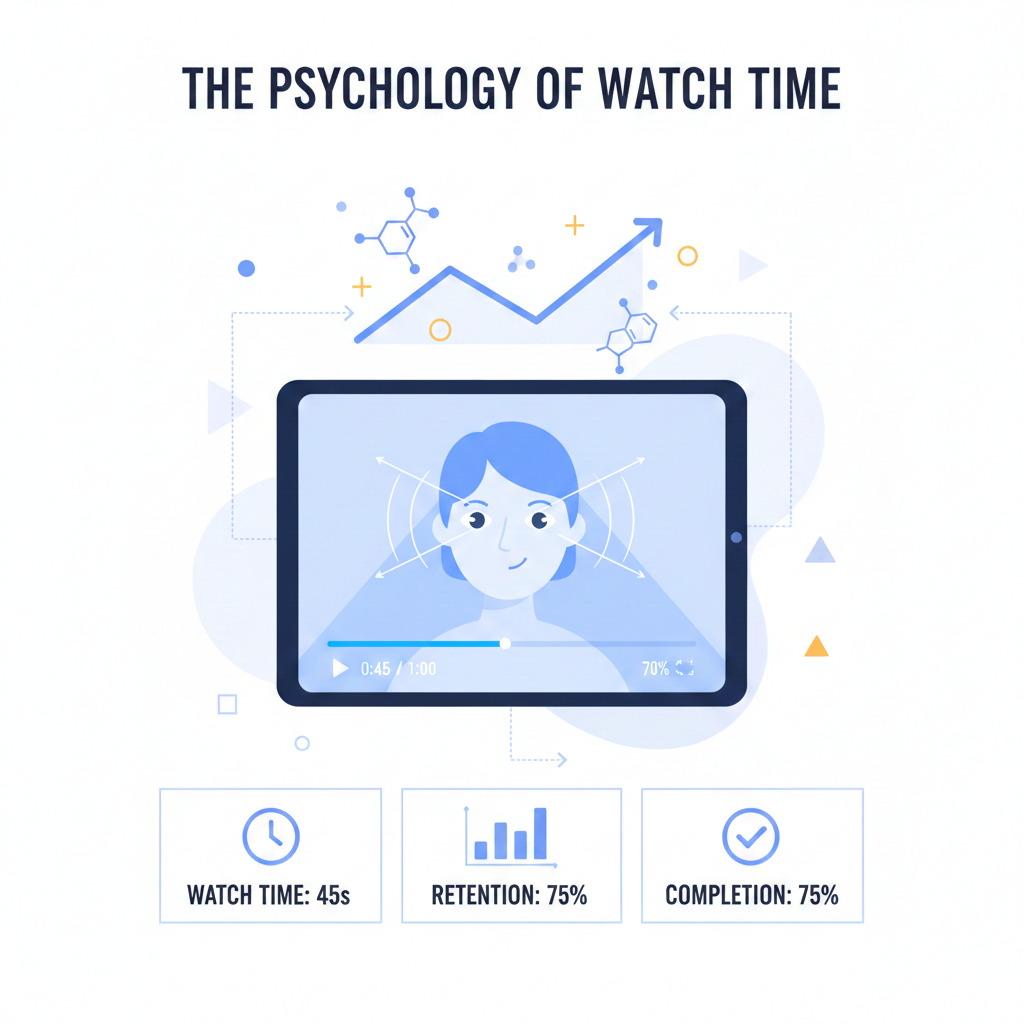
What Watch Time Actually Measures
Many creators assume watch time is about video length. In reality, it measures cognitive engagement.
Platforms evaluate:
How long viewers stay
Whether they rewatch
Whether they continue watching more content
This is why videos with fewer views but higher retention often outperform viral clips that lose attention early. The same principle explains why hookless content sometimes performs better when the value delivery is immediate, a concept explored in Why Hookless Reels Sometimes Perform Better.
Watch time reflects how mentally rewarding your content feels.
Attention Is Psychological, Not Visual
High production quality no longer guarantees retention. The brain adapts to aesthetics quickly. What sustains attention is mental momentum.
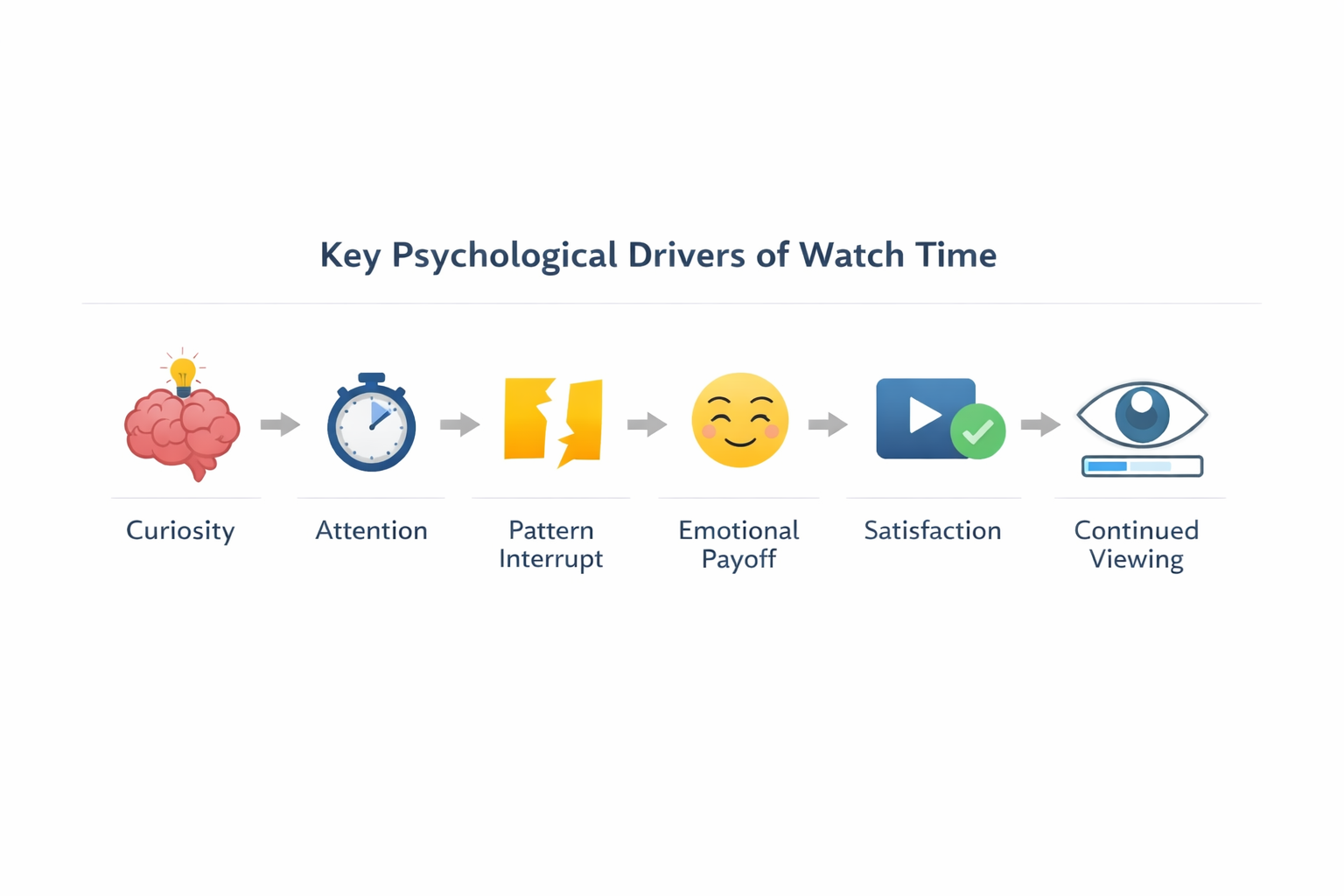
Three psychological forces drive watch time:
Curiosity gaps
Pattern completion
Emotional payoff
If your video activates at least two of these, viewers are far more likely to stay.
Curiosity Gaps Keep the Brain Invested
The human brain dislikes incomplete information. When a question is opened but not immediately answered, attention increases.
Weak hook:
“This will change your content.”
Strong hook:
“Most videos fail because of one mistake in the first 5 seconds.”
This aligns closely with the first-seconds principle, also discussed in The Scroll-Stopping Formula: how to make people STOP instantly.
To use curiosity gaps effectively:
Introduce a clear problem early
Delay resolution with intention
Always deliver the promised insight
Unresolved loops break trust and reduce future watch time.
Pattern Interrupts Prevent Attention Drop-Off
The brain constantly predicts what comes next. When content becomes predictable, attention fades.
Pattern interrupts reset focus without confusion:
A shift in tone
A pacing change
A visual transition
A new framing angle
Used correctly, they prevent mental fatigue and increase retention. Overuse, however, creates chaos.
Cognitive Load Must Stay Balanced
High watch time lives between boredom and overwhelm.
If content is too simple, viewers disengage.
If it is too complex, they drop off.
This is why high-value simplicity consistently outperforms overproduced feeds, a concept expanded in Why “High-Value Simplicity” Beats Aesthetic Feeds Now.
Design each segment around:
One idea
One insight
One takeaway
The brain rewards clarity.
Dopamine Loops and Micro-Rewards
Addictive videos deliver small psychological rewards frequently.
These rewards can be:
A realization
A useful framework
A belief reframed
Each reward reinforces continued viewing. This is why educational content with clear structure often outperforms purely entertaining videos.
According to YouTube’s official Creator Academy, retention improves when viewers feel they are learning or progressing through an idea rather than passively watching content (source: https://creatoracademy.youtube.com).
Emotional Regulation Increases Watch Time
People use content to regulate emotion.
High-performing videos often:
Reduce confusion
Increase confidence
Provide clarity
Validate uncertainty
When viewers feel more capable after watching, they stay longer and return more often.
This principle aligns with how audience signals influence distribution, particularly on long-form platforms, as explained in Audience Signals: how YouTube decides who to push your video to.
Open Loops Outperform Instant Payoffs
Giving everything upfront may feel efficient, but it kills retention.
High watch-time videos:
Introduce value
Expand understanding
Deepen context
Deliver resolution
This mirrors how humans naturally learn. We want understanding, not just answers.
Rewatchability Multiplies Watch Time
Platforms heavily reward rewatch behavior.
Rewatchable content:
Moves fast
Delivers dense value
Reveals new insights on repeat viewing
This is why short, information-rich videos often outperform longer ones.
TikTok’s newsroom has also confirmed that rewatches and completion rate strongly influence distribution (source: https://www.tiktok.com/business/en/blog).
Watch Time Extends Beyond Your Video
Watch time includes what happens after your content ends.
If viewers continue watching more videos, platforms assign higher trust to your content. This is why consistent structure, clarity, and value matter more than hype.
When people trust your content, session time increases.
Designing Videos With Watch Time in Mind
Before publishing, ask:
Does the opening create a clear mental question?
Is each section rewarding attention?
Are there intentional pattern interrupts?
Is the message simple but meaningful?
Does the ending feel complete?
If yes, you are not chasing watch time. You are earning it.
How Reachism Fits Into Watch Time Psychology
Reachism aligns with watch time psychology by focusing on how real people engage with content, not by chasing algorithm tricks. It emphasizes clear structure, strong value delivery, and intentional pacing so viewers stay longer because the content feels useful and satisfying. Instead of optimizing for clicks alone, Reachism helps creators design videos that maintain attention, build trust, and encourage continued viewing exactly the behaviors platforms reward with greater reach.
Final Thought
Watch time is not a hack. It is not manipulation. It is psychology.
When your videos:
Respect attention
Reward curiosity
Reduce confusion
Deliver clarity
watch time becomes a natural outcome.
And when watch time rises, reach follows. Not because you gamed the algorithm,
but because you understood the human mind.