- What Is Faceless YouTube Automation?
- Why Busy Creators Are Drawn to Automation
- Why Most Faceless Automation Channels Fail
- What Parts of a YouTube Channel Should Be Automated?
- The Best Faceless YouTube Formats for Busy Creators
- Building the Core Content System
- Step 1: Create a topic map
- Step 2: Use repeatable script templates
- Step 3: Build a production checklist
- Step 4: Batch content in stages
- Step 5: Review analytics monthly
- How to Keep Automated Content From Feeling Generic
- Pro Tip: Automate the System, Not the Insight
- What a Weekly Workflow Can Look Like
- Conclusion: Automation Works When Structure Leads
Faceless YouTube automation sounds efficient, but most creators misunderstand what it actually requires.
Automation is not uploading low-quality videos at scale and hoping the algorithm does the rest. It is the deliberate building of repeatable content systems so a channel can grow without demanding constant filming, editing, and on-camera presence from the creator.
For busy creators, that distinction matters. If you want a faceless YouTube channel that saves time and still grows, you need structure, not shortcuts. The real opportunity in faceless YouTube automation is not speed alone. It is consistency, leverage, and operational clarity.
This guide explains how to build content systems for busy creators who want sustainable growth without becoming the bottleneck.
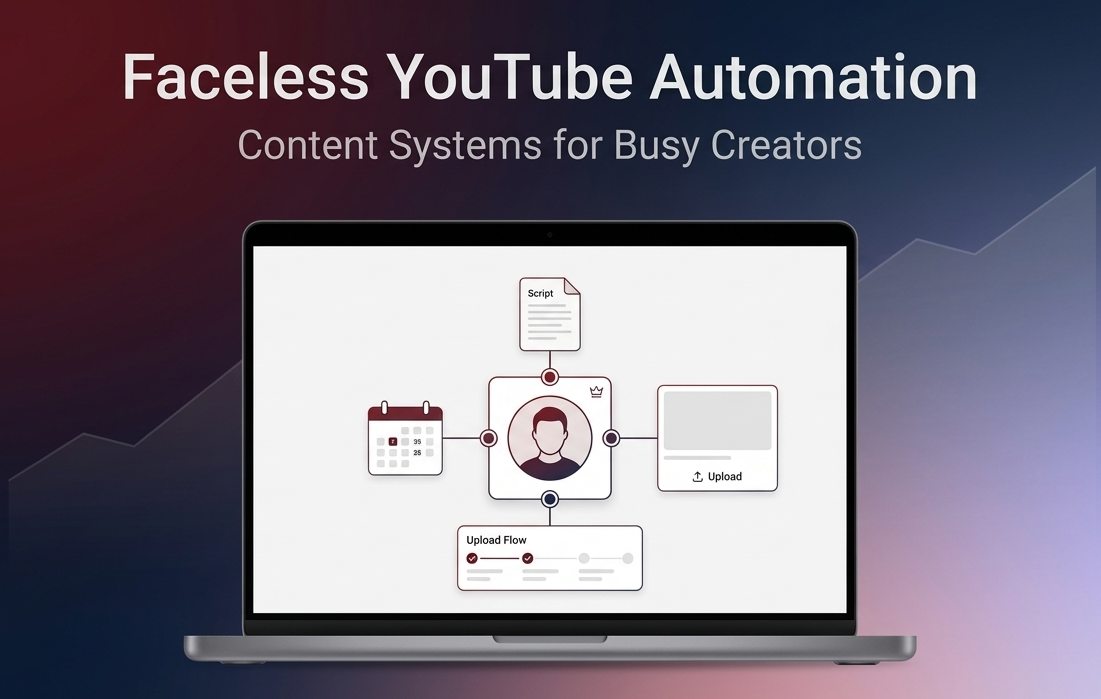
What Is Faceless YouTube Automation?
Faceless YouTube automation is the process of creating videos without relying on your face or daily personal presence, while systemizing recurring tasks such as research, scripting, editing, voiceover, design, and publishing.
That can include:
Scripted educational videos
Voiceover explainers
Screen-recording tutorials
Curated visual storytelling
Data-led commentary videos
AI-assisted workflow support
The word automation often creates the wrong expectation. YouTube does not reward channels for being automated. It rewards channels for satisfying viewers. According to YouTube’s official documentation on recommendations and search, performance still depends on click-through rate, watch time, and viewer satisfaction.
Automation only helps if it protects those outcomes.
Why Busy Creators Are Drawn to Automation
The appeal is obvious. Many creators have jobs, clients, studies, or businesses. They cannot record daily, stay camera-ready, or manage every production step manually.
A faceless system offers three major advantages:
1. Lower production friction
If the channel does not depend on personal filming every time, content becomes easier to plan and batch.
2. Easier delegation
Tasks like thumbnail design, rough editing, transcription, and research can be handed off more easily when the format is repeatable.
3. Greater consistency
Busy creators rarely fail because they lack ideas. They fail because the workflow collapses under time pressure. Systems solve that.
This is why faceless growth often overlaps with How to Build a Faceless YouTube Channel That Actually Grows, where structure replaces personality as the primary growth lever.
Why Most Faceless Automation Channels Fail
Most failures come from a misunderstanding of what should be automated and what should stay strategic.
Creators often automate the visible work while neglecting the thinking work.
That leads to channels with:
Generic topics
Weak scripts
Poor packaging
Repetitive visuals
No distinct positioning
Automation without strategy produces volume, not authority.
If your niche is broad and your ideas are recycled, scaling output will only scale mediocrity. That is why systems must begin with niche clarity and audience intent, not editing shortcuts.
What Parts of a YouTube Channel Should Be Automated?
Not everything should be automated equally. The strongest channels automate operations while protecting strategic judgment.
Best areas to systemize
Topic research workflow
Script outline templates
Editing checklists
Thumbnail production process
Upload and publishing workflow
Content calendar management
Repurposing process
Areas that still need strong human oversight
Niche positioning
Topic selection
Hook quality
Packaging decisions
Final script clarity
Brand voice
Performance analysis
That balance matters. A creator can automate execution, but the channel still needs a point of view.
The Best Faceless YouTube Formats for Busy Creators
Not every format is equally automation-friendly. The best formats have repeatable structure and clear viewer intent.
1. Educational explainers
Topics with clear teaching angles work well because they can follow a stable script structure and use visual support instead of a talking head.
Examples:
Marketing breakdowns
AI tool tutorials
Productivity systems
Finance basics
2. Screen-recording tutorials
If your niche involves software, research, or workflows, screen-based videos reduce filming needs and keep production efficient.
3. Voiceover commentary
These work well when paired with charts, B-roll, screenshots, or graphics. They are especially effective for analysis-heavy niches.
4. List-based strategic videos
These are highly systemizable when the topic demands comparison, prioritization, or clear steps.
This also connects with Search-Based YouTube Videos: the formats that always rank, because search-driven formats are often easier to automate than personality-heavy entertainment content.
Building the Core Content System
A strong faceless channel needs an operating system, not a random upload habit. Here is the practical structure.
Step 1: Create a topic map
Build one core niche, then break it into subtopics.
For example:
Core niche: YouTube growth
Subtopics:
Retention
Search strategy
Packaging
Channel positioning
Analytics
Now each upload supports the next. This creates authority rather than isolated content.
Step 2: Use repeatable script templates
Instead of starting from zero every time, use formats such as:
Problem → cause → fix
Tool → use case → result
Mistake → consequence → correction
Framework → breakdown → application
Templates reduce creative fatigue without making the content feel robotic.
Step 3: Build a production checklist
A simple checklist keeps quality stable across uploads:
Topic validated
Title angle chosen
Hook written
Script approved
Voiceover recorded
Visuals added
Thumbnail completed
SEO fields optimized
Upload scheduled
Busy creators grow faster when decisions are standardized.
Step 4: Batch content in stages
Instead of making one full video at a time, batch by function:
Research 5 topics
Outline 5 scripts
Record 5 voiceovers
Edit in one production block
Review thumbnails together
Batching reduces setup time and increases consistency.
Step 5: Review analytics monthly
Automation should improve efficiency, not disconnect you from performance.
Review:
CTR
first 30-second retention
average view duration
returning viewers
top topics by watch time
This is where YouTube Data Analysis: reading analytics like a strategist becomes important. A faceless system still needs strategic feedback loops.
How to Keep Automated Content From Feeling Generic
The biggest danger in faceless automation is sameness.
To avoid that:
Use a clear point of view
Bring niche-specific insight
Write stronger openings
Use better examples
Maintain visual consistency
Avoid stock-footage overload
The content should feel designed, not assembled.
This is also where YouTube Branding: making your channel unforgettable matters. A faceless channel still needs identity. Recognition does not require a face, but it does require consistency in tone, visuals, and value.
Pro Tip: Automate the System, Not the Insight
This is the principle most creators need.
Automate:
workflow
scheduling
templates
delegation
publishing operations
Do not automate:
judgment
positioning
originality
audience understanding
The best faceless channels feel efficient behind the scenes but thoughtful on the screen.
Platforms like Reachism https://reachism.com/ are useful reference points for this kind of system-driven thinking because they focus on structural growth instead of superficial hacks. That mindset is exactly what faceless automation needs.
What a Weekly Workflow Can Look Like
For a busy creator, a lean weekly system could look like this:
Day | Focus |
|---|---|
Monday | Topic research and outlines |
Tuesday | Script writing |
Wednesday | Voiceover recording |
Thursday | Editing and thumbnails |
Friday | Review, optimize, schedule |
This kind of workflow makes growth realistic for creators with limited hours.
Conclusion: Automation Works When Structure Leads
Faceless YouTube automation can absolutely work for busy creators, but only when the channel is built on systems that protect quality, clarity, and strategy.
The goal is not to remove effort completely. The goal is to remove friction where it does not matter, so your time is spent on the few decisions that actually drive growth.
If you want a faceless channel that grows:
choose a format that fits your schedule
build repeatable workflows
batch production in stages
protect strategic thinking
review performance regularly
Automation is not the advantage by itself.
A well-designed content system is.