- What Metrics Actually Matter on YouTube?
- The Three Core Levers of YouTube Growth
- 1. Click-Through Rate: Packaging Performance
- 2. Audience Retention: Content Performance
- 3. Audience Fit: Relevance Performance
- How to Diagnose Performance Strategically
- The Hidden Metric: Session Contribution
- Using Analytics to Plan Your Next Upload
- Common YouTube Analytics Mistakes
- Pro Tip: Benchmark Against Yourself
- Build a Monthly Analytics Review System
- Performance Comparison: Tactical vs Strategic Analysis
- Conclusion: Data Is Direction
YouTube data analysis is not about checking views. It is about diagnosing leverage.
Most creators open YouTube Studio, glance at subscriber count, and close it. Strategists look at patterns, relationships between metrics, and bottlenecks inside the growth system.
If you want to grow on YouTube consistently, you must read analytics like a strategist. That means understanding how click-through rate, retention, and audience signals interact.
This guide explains how to interpret YouTube analytics structurally so every upload becomes a data-backed improvement.
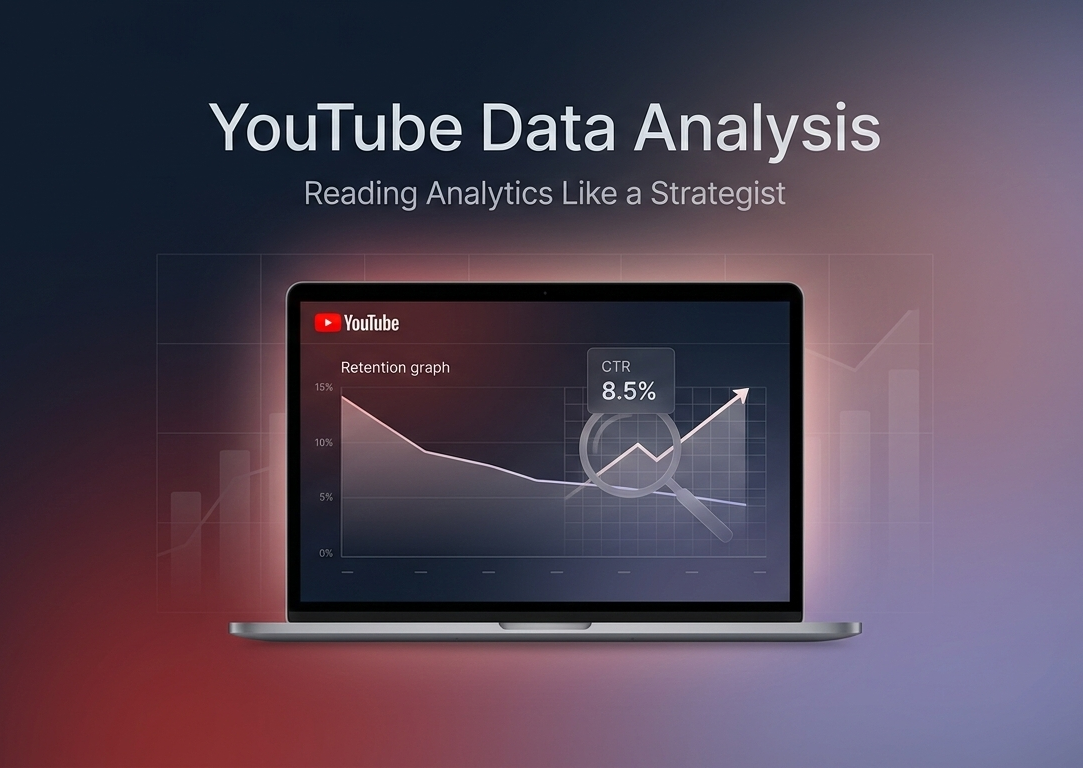
What Metrics Actually Matter on YouTube?
According to YouTube’s official documentation on how recommendations work the platform prioritizes:
Click-through rate
Watch time
Viewer satisfaction
Session contribution
Most creators treat these as isolated metrics. They are interconnected.
YouTube does not reward individual numbers. It rewards combinations.
The Three Core Levers of YouTube Growth
YouTube performance is typically governed by three structural layers:
Packaging
Retention
Audience Fit
Let’s break them down.
1. Click-Through Rate: Packaging Performance
Click-through rate, or CTR, measures how many people clicked after seeing your thumbnail and title.
High impressions + low CTR = packaging problem.
Before rewriting your script, ask:
Is the title specific?
Does the thumbnail create tension?
Is the topic aligned with audience expectations?
If CTR is below your channel average, your growth bottleneck is before the video even starts.
To refine packaging strategy, study principles from How to Craft Titles & Thumbnails That Print Views and test variations over time.
2. Audience Retention: Content Performance
Retention reveals where viewers leave.
Open YouTube Studio and examine:
First 30-second retention
Average view duration
Drop-off spikes
If retention drops sharply in the first 15 seconds, your hook or intro is weak.
If retention drops mid-video, your pacing or structure needs adjustment.
This is where frameworks like Breaking Down the Perfect YouTube Script Structure become essential. Structure determines retention more than topic choice.
Retention drives recommendation expansion.
3. Audience Fit: Relevance Performance
Sometimes CTR and retention look decent, yet growth stalls.
This often indicates audience mismatch.
Check:
Traffic sources
New vs returning viewers
Audience demographics
Suggested video associations
If your video is being recommended next to unrelated content, the algorithm may not fully understand your niche.
This connects with the logic behind The YouTube Content Gap Method: finding topics that explode, where niche positioning strengthens algorithmic clarity.
How to Diagnose Performance Strategically
Instead of asking “Why did this video fail?” ask:
Where is the bottleneck?
Use this decision tree:
Low CTR + high impressions = Packaging issue
High CTR + low retention = Content issue
High retention + low impressions = Topic or niche clarity issue
This systematic thinking separates emotional reaction from strategic refinement.
The Hidden Metric: Session Contribution
YouTube values how your video contributes to overall session time.
If viewers watch your video and then continue watching other videos, your content becomes valuable to the platform.
Check “Top videos suggesting your content” inside YouTube Studio.
If your video frequently leads to long session chains, you are building algorithmic trust.
If viewers exit YouTube after watching, your session contribution weakens.
Encouraging follow-up videos through structured clusters improves this metric.
Using Analytics to Plan Your Next Upload
Strategic creators do not create randomly. They iterate based on patterns.
For example:
If a video about “AI tools for freelancers” shows:
High CTR
Strong retention
Growing suggested traffic
That topic becomes a cluster.
Expand into:
Advanced AI workflows
Beginner setup guide
Mistakes freelancers make with AI
This mirrors systems emphasized by platforms like Reachism https://reachism.com/, where structured growth replaces random experimentation.
Analytics should shape your roadmap.
Common YouTube Analytics Mistakes
Obsessing over subscriber count
Comparing individual videos without context
Ignoring traffic source breakdown
Overreacting to one underperforming upload
Failing to test consistently
Strategic analysis requires pattern recognition across multiple uploads.
Pro Tip: Benchmark Against Yourself
Instead of comparing your channel to million-subscriber creators, compare:
CTR to your channel average
Retention to your previous uploads
Topic performance within your niche
Improvement is relative to your baseline.
Build a Monthly Analytics Review System
Once per month:
Identify top 3 performing videos
Identify bottom 3 performing videos
Compare packaging, structure, and topic
Extract patterns
Apply adjustments next cycle
This creates feedback loops.
Feedback loops create growth.
Performance Comparison: Tactical vs Strategic Analysis
Tactical Creator | Strategic Creator |
|---|---|
Checks views | Analyzes bottlenecks |
Blames algorithm | Refines packaging or retention |
Reacts emotionally | Adjusts systematically |
Posts randomly | Expands proven clusters |
Analytics are not numbers. They are signals.
Conclusion: Data Is Direction
YouTube data analysis is not about vanity metrics. It is about leverage identification.
When you read analytics like a strategist, you can:
Improve CTR intentionally
Fix retention drop-offs
Strengthen niche clarity
Expand successful clusters
Growth stops being mysterious.
Every metric becomes feedback.
Every upload becomes an experiment.
Every improvement compounds.
The creators who scale fastest are not guessing. They are reading the data correctly.