- 1. Start With the Only Metric That Truly Matters: Retention
- 2. Understand the Difference Between Reach Metrics and Quality Metrics
- 3. Analyze Rewatches: The Hidden Growth Multiplier
- 4. Saves and Shares Matter More Than Likes (Here’s Why)
- 5. Profile Actions: The Conversion Layer Most Creators Ignore
- 6. Contextual Analysis: Compare Reels, Don’t Isolate Them
- 7. Platform-Specific Signals You Must Factor In
- 8. Build a Simple Pro-Level Reel Analysis Framework
Most creators look at views and likes and assume they understand performance. Pros don’t.
Professional Reel analysis focuses on viewer behavior, algorithm signals, and conversion impact, not surface-level numbers.
1. Start With the Only Metric That Truly Matters: Retention
If your Reel doesn’t hold attention, nothing else matters.
Key retention checkpoints to analyze:
0–3 seconds: Did viewers stop scrolling?
3–7 seconds: Did curiosity increase or collapse?
50% watch mark: Did your promise get fulfilled?
Completion rate: Was the ending satisfying or abrupt?
A Reel with lower views but higher retention often outperforms a high-view Reel long-term. Algorithms reward watch behavior, not popularity.
👉 https://reachism.com/blog/the-psychology-of-watch-time-how-to-design-addictive-videos
2. Understand the Difference Between Reach Metrics and Quality Metrics
Pros separate metrics into two categories:
Reach Metrics (Distribution Signals)
Impressions
Reach
Initial velocity (first 30–60 minutes)
Quality Metrics (Algorithm Trust Signals)
Average watch time
Rewatches
Shares to DMs
Saves
A Reel can fail on reach but succeed on quality—and still be pushed later. Many viral Reels start slow and accelerate once quality signals stabilize.
This is why most TikTok and Instagram videos “die early” not because they’re bad, but because they fail to prove value quickly.
3. Analyze Rewatches: The Hidden Growth Multiplier
Rewatches tell the algorithm one thing: this content had more value than time.
Reels that get replayed usually have:
Dense information packed into short runtime
A twist, reveal, or layered meaning
Visual pacing that rewards second viewing
When analyzing performance, compare:
Average watch time vs Reel length
Completion rate vs rewatch rate
If average watch time exceeds total length, you’ve created loop-driven content one of the strongest positive signals available.
This connects directly to our framework on value density: packing more meaning into fewer seconds creates exponential reach.
4. Saves and Shares Matter More Than Likes (Here’s Why)
Likes are emotional reactions.
Saves and shares are intent-based actions.
What each signal means:
Save: “This is useful later”
Share: “This represents me or helps someone else”
DM share: Highest trust signal on Instagram
When analyzing Reels, always ask:
Why would someone need this again—or need someone else to see it?
Educational clarity, emotional resonance, and practical utility drive these metrics not aesthetics.
This is why “pretty” content often underperforms compared to clear content.
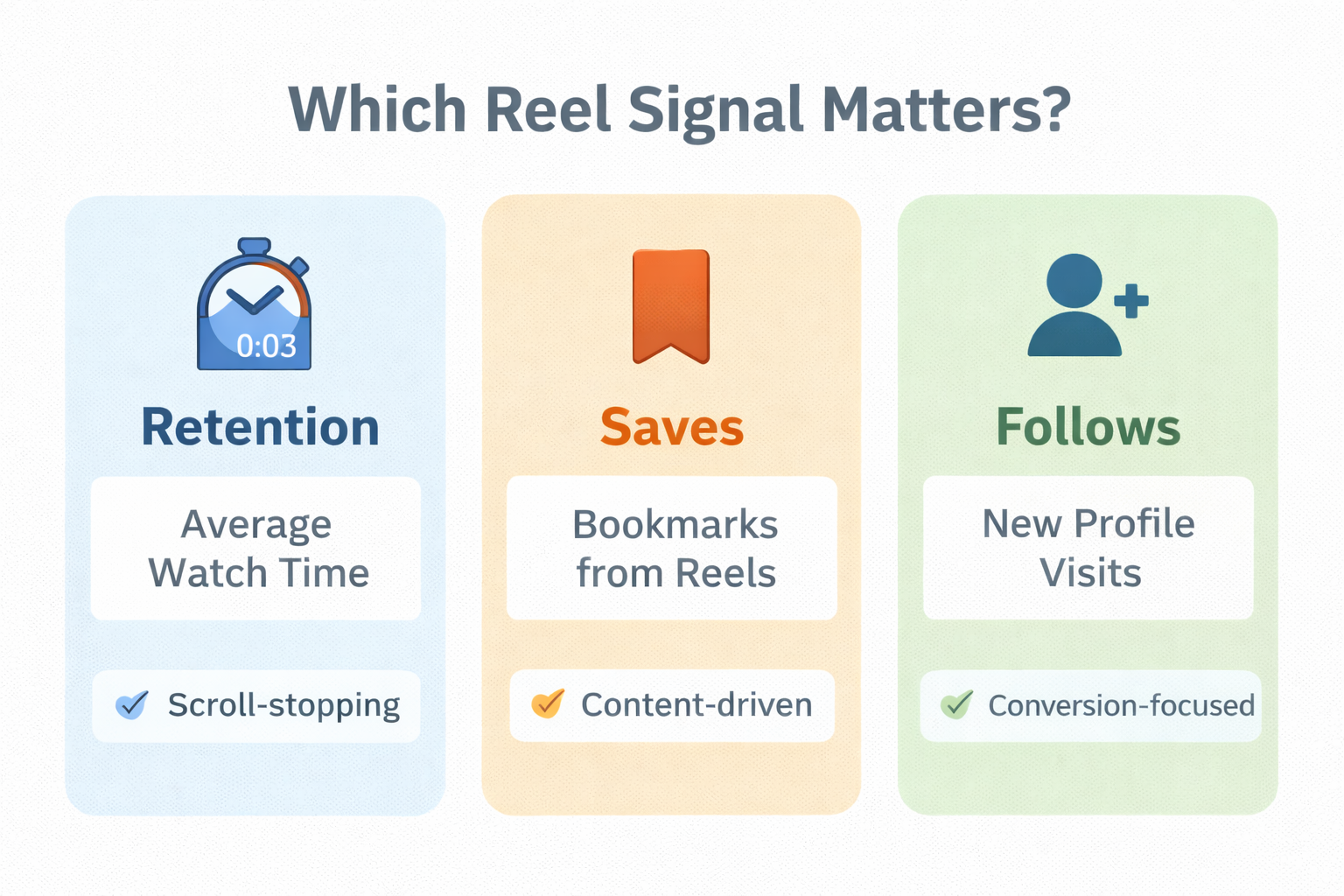
5. Profile Actions: The Conversion Layer Most Creators Ignore
Professional analysis goes beyond the Reel itself.
Check what happens after the view:
Profile visits
Follows from the Reel
Bio clicks
Content binge behavior
A Reel that gets fewer views but high follow conversion is more valuable than a viral Reel that attracts the wrong audience.
This is the foundation of sustainable growth and exactly why we emphasize clarity over trends at Reachism. Your content should attract the right people, not just more people.
6. Contextual Analysis: Compare Reels, Don’t Isolate Them
Never analyze a Reel alone.
Instead, compare:
Same hook, different structure
Same topic, different pacing
Same length, different CTA
Patterns emerge only through contrast. Pros document what changes outcomes, not what “went viral.”
This is also how creators reverse-engineer success instead of chasing luck.
7. Platform-Specific Signals You Must Factor In
Instagram Reels
Saves + DMs = strongest signals
Looping behavior increases secondary distribution
Profile retention matters heavily
TikTok Reels
Completion rate heavily impacts push
Comment velocity affects expansion
Early audience matching decides scale
8. Build a Simple Pro-Level Reel Analysis Framework
After posting every Reel, answer these five questions:
Did it stop the scroll fast enough?
Did viewers stay longer than average?
Did it earn a save or share?
Did it attract the right audience?
What would I remove, tighten, or clarify next time?
This turns content creation into a feedback system not a guessing game.