- Why scripting matters more than most beginners think
- What does a professional YouTube script actually look like?
- The easiest scripting framework for beginners
- How to write the hook without sounding fake
- How to make the middle of the script engaging
- Should you script every word or use bullet points?
- How to make your script sound natural
- A simple YouTube script template you can reuse
- Common scripting mistakes beginners should avoid
- Pro tip
- Where Reachism fits into this
- Conclusion
Beginners usually make one of two mistakes. Either they ramble with no plan, or they overwrite and sound robotic. A strong script sits in the middle. It feels natural to the viewer, but deliberate underneath. That is what makes it professional.
Why scripting matters more than most beginners think
A script is not just a writing document. It is your retention blueprint.
YouTube says its systems look at whether viewers choose to watch a recommended video, whether they stick around, and whether they seem satisfied afterward. That means your script influences the most important parts of performance before editing even begins.
Good scripting helps you:
start with a clearer hook
remove filler and repetition
keep pacing tight
create stronger transitions
make editing easier
This is why creators who want stable growth eventually stop improvising everything. If you are serious about building a channel, scripting is part of the infrastructure, just like packaging and analytics.
What does a professional YouTube script actually look like?
A professional script is not necessarily long. It is organized.
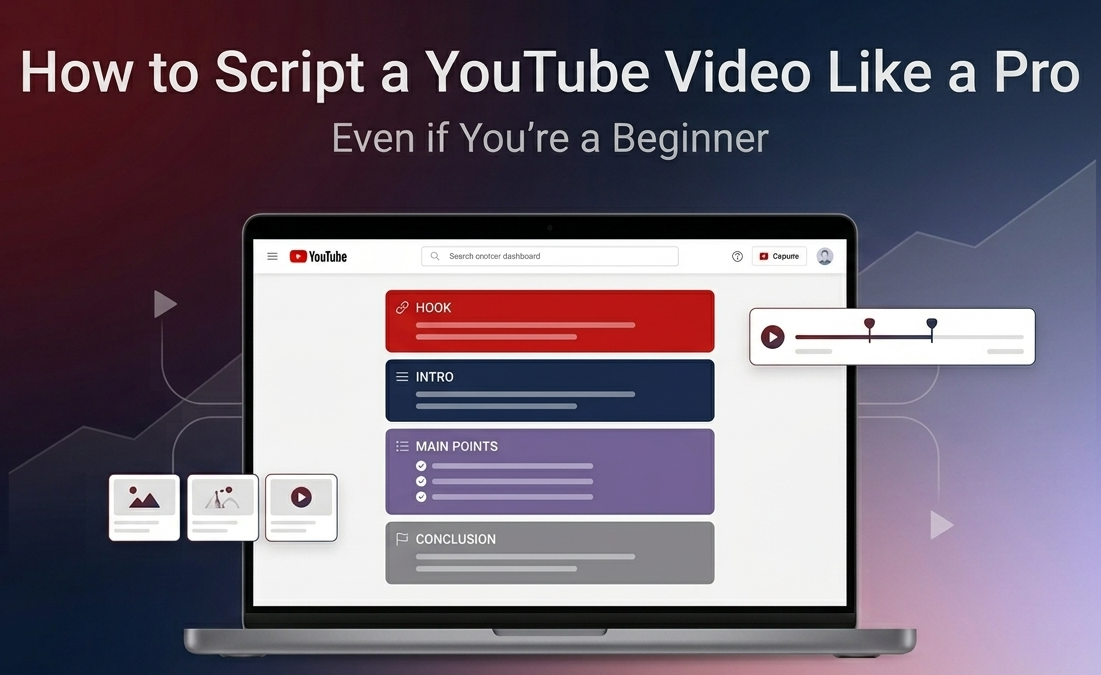
Most strong YouTube scripts follow a simple flow:
1. Hook
The opening gives the viewer a reason to care now.
2. Setup
You explain what the video is about and why it matters.
3. Main body
You deliver the content in a logical order.
4. Payoff
You bring the main promise together clearly.
5. Next step
You guide the viewer toward another action, insight, or video.
That structure matters because viewers do not keep watching only for information. They keep watching because the information is sequenced well. This is closely connected to Breaking Down the Perfect YouTube Script Structure because weak structure often causes the drop-offs creators later blame on the algorithm.
The easiest scripting framework for beginners
If you are new, use this four-part formula:
Problem → Why it matters → Solution → Next step
Here is a simple example.
Topic: How to improve YouTube retention
Problem: “Most creators lose viewers in the first 30 seconds.”
Why it matters: “That early drop tells YouTube the video is weak.”
Solution: “You need a stronger opening, faster context, and tighter transitions.”
Next step: “I’ll break down each part so you can fix it in your next upload.”
This works because it immediately gives the viewer orientation. They know what the issue is, why they should care, and what they are about to get.
How to write the hook without sounding fake
The hook is where most beginners panic. They either say something too generic or try to sound dramatic.
A better approach is simple. Open with one of these:
a specific problem
a surprising insight
a clear promised outcome
a strong contrast
Examples:
“Most beginner YouTubers script backwards.”
“If your videos feel boring, the problem is usually your structure.”
“Here’s the easiest way to script a YouTube video without sounding robotic.”
The hook should create momentum, not theater. You do not need to sound like a trailer voice. You just need to make the next sentence feel worth hearing.
For stronger openings, this topic naturally connects with YouTube Hooks That Work: intros viewers can’t skip
How to make the middle of the script engaging
The middle is where beginners lose viewers.
Usually the problem is not lack of value. It is lack of flow. They dump information instead of building it.
To keep the middle strong:
break the topic into clean sections
keep each section focused on one idea
use transitions that pull the viewer forward
cut any line that repeats what was already said
For example, instead of saying:
“Now let’s talk about the next point. This next point is very important. A lot of people ignore this next point.”
Say:
“The next mistake is pacing. Even a strong idea falls flat if the explanation drags.”
That sounds tighter, clearer, and more professional.
According to Wistia’s scripting guidance, strong video scripts benefit from clear planning and simple language rather than overwritten phrasing. That is especially true on YouTube, where viewers decide quickly whether to stay with you.
Should you script every word or use bullet points?
It depends on your style, but beginners usually do better with a full draft first.
A full draft helps you:
find weak sections before filming
remove rambling
improve transitions
feel more confident on camera
Once you get more experienced, you may switch to a hybrid method where you fully script the hook and key lines, then speak more freely in the body.
A useful progression looks like this:
Stage | Best scripting method |
|---|---|
Beginner | Full script |
Intermediate | Detailed outline with key lines |
Advanced | Bullet structure with planned beats |
If you are still learning delivery, a full script is not a crutch. It is training.
How to make your script sound natural
This is where many people get stuck. They write in essay language, then wonder why their video sounds stiff.
Try these fixes:
write how you speak
use shorter sentences
read the script aloud while editing
remove any phrase you would never say in real life
keep one sentence doing one job
A good test is simple. If a sentence feels awkward in your mouth, it will probably feel awkward to the viewer too.
This is also why many creators benefit from writing the first draft plainly, then tightening it for rhythm. Professional scripting is often less about adding sophistication and more about removing friction.
A simple YouTube script template you can reuse
Here is a reusable structure:
Opening hook
Start with the problem, promise, or tension.
Quick setup
Tell the viewer what they will learn and why it matters.
Point 1
Introduce the first core idea with an example.
Point 2
Build on the first idea with a deeper insight or correction.
Point 3
Deliver the most useful or strategic takeaway.
Conclusion
Wrap up the lesson clearly.
Call to action
Point them to the next relevant video or action.
This works especially well for educational and strategy content.
Common scripting mistakes beginners should avoid
Here are the most common ones:
starting with long greetings
taking too long to explain the topic
repeating the same point in different words
using complicated language to sound smart
writing transitions that add no value
ending abruptly with no payoff
A script should feel like guided momentum. Every section should make the next one easier to watch.
Pro tip
Write your intro last.
This sounds backwards, but it works. Once the rest of the video is clear, it becomes much easier to write an opening that accurately sets up the value. Many creators force the hook too early and end up with an intro that sounds disconnected from the actual video.
It is also smart to keep a swipe file of strong openings, transitions, and conclusions from your own best-performing videos. Over time, scripting gets faster because you are not reinventing your voice every week.
Where Reachism fits into this
If you are building educational or strategy-driven content, Reachism can be a useful reference point for how structured content supports growth. The site’s content focus leans heavily into systems, content architecture, and platform-specific strategy, which is exactly the mindset that improves scripting over time. Instead of thinking, “What should I say in this video?” you start thinking, “What sequence will hold attention and deliver the promise clearly?”
That shift is what separates random content from reliable content.
Conclusion
If you want to learn how to script a YouTube video like a pro, start by forgetting the idea that pros are simply more charismatic. Most of the difference comes from structure. A professional script gives the viewer a reason to care, moves through ideas clearly, and makes the next sentence feel worth hearing.
As a beginner, you do not need perfect delivery. You need a repeatable system. Start with a simple framework, write for clarity, cut repetition, and build your videos around momentum. Over time, your scripting will improve, your retention will get stronger, and your channel will feel far more intentional. That is how beginners stop sounding like beginners.