A great YouTube video rarely succeeds by accident. Behind every video that holds attention, builds trust, and converts viewers into subscribers is a well-structured script. Not a rigid screenplay, but a strategic framework that aligns with how people think, scroll, and decide whether to keep watching.
In this guide, we’ll break down the perfect YouTube script structure step by step. You’ll learn not only what to say, but when and why to say it, based on real viewer behavior and modern YouTube recommendation signals.

Why Script Structure Matters More Than Ever on YouTube
YouTube doesn’t rank videos because they are long or visually polished. It ranks videos because people stay.
Your script directly affects:
Watch time and average view duration
Early retention in the first 30–60 seconds
Viewer satisfaction signals like likes, comments, and subscriptions
A weak structure leads to drop-offs, even if the idea is good. A strong structure makes average ideas perform exceptionally well.
Think of your script like a guided experience. Viewers don’t want to feel lost, bored, or misled. They want clarity, momentum, and payoff.
The Core Psychology Behind High-Retention Scripts
Before diving into the structure itself, it’s important to understand how viewers consume YouTube content.
Viewers subconsciously ask three questions:
Is this for me?
Is it worth my time?
What do I get if I keep watching?
The perfect script answers these questions without explicitly asking them. It shows value early, reinforces relevance throughout, and delivers a clear payoff at the end.
The Perfect YouTube Script Structure (Step by Step)
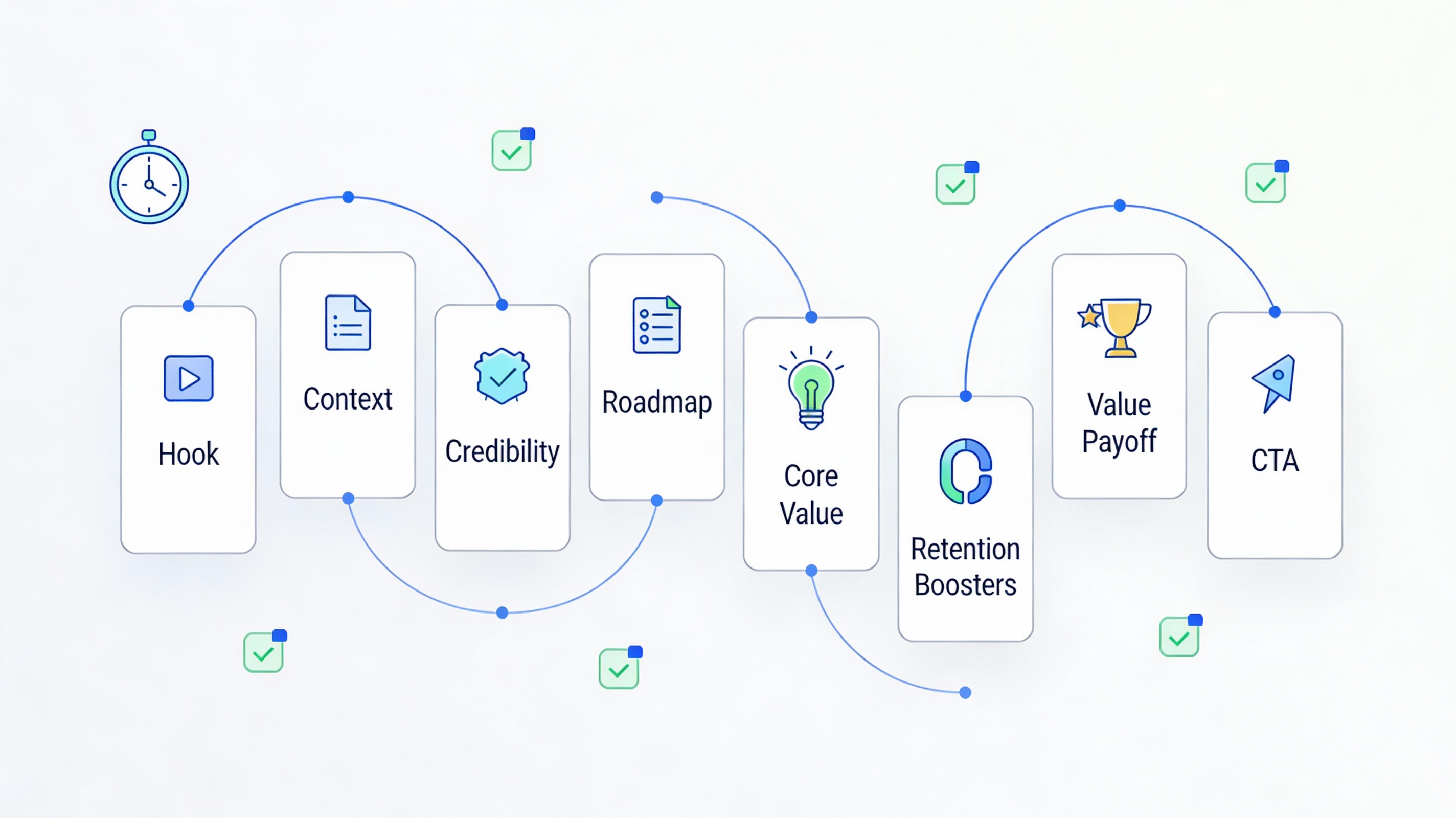
1. The Pattern-Breaking Hook (0–10 seconds)
This is the most critical part of your script.
Your hook’s job is not to explain the video. It’s to interrupt scrolling with scroll-stopping hooks and create curiosity. Strong hooks usually do one of three things:
Challenge a common belief
Show a surprising result
Present a clear gap between where the viewer is and where they want to be
Example:
Instead of saying, “In this video, I’ll show you how to grow on YouTube,”
you say, “Most YouTube videos fail in the first 15 seconds, and it has nothing to do with editing.”
2. The Immediate Context Reset (10–25 seconds)
After the hook, viewers need orientation.
This section reassures them that:
They clicked the right video
You understand their problem
There’s a clear direction ahead
This is where you briefly explain what the video will help them achieve, without dragging it out.
Example:
“By the end of this video, you’ll have a simple script framework you can use for any YouTube video, whether you’re teaching, storytelling, or selling.”
This step reduces early drop-offs and increases trust.
3. The Credibility Bridge (Optional but Powerful)
Viewers don’t need your entire resume. They need a reason to listen.
Credibility can come from:
Experience (“We’ve analyzed hundreds of high-retention videos”)
Observation (“After breaking down top-performing channels…”)
Results (“This structure increased our average watch time by 40%”)
Keep this short and natural.
4. The Clear Roadmap (Expectation Setting)
People stay longer when they know what’s coming.
Outline the structure of the video in simple terms:
What you’ll cover
In what order
Why each part matters
Example:
“We’ll start with the opening hook, then break down the middle section that keeps people watching, and finally show you how to end videos in a way that drives subscribers.”
This reduces anxiety and builds commitment.
5. The Core Value Sections (The Middle That Most Creators Ruin)
This is where most videos lose momentum.
The mistake? Dumping information without structure.
Instead, break your core content into clear segments, each with:
A mini-promise
A practical takeaway
A transition to the next idea
Think of each section as its own reason to keep watching.
For example:
Section 1: Why most intros fail
Section 2: The retention-first scripting mindset
Section 3: A repeatable script template
Section 4: Common mistakes to avoid
6. Retention Boosters Inside the Script
High-performing scripts intentionally keep attention alive.
Effective techniques include:
Open loops (“We’ll come back to this in a minute”)
Soft curiosity gaps
Occasional pattern changes in pacing
Relatable micro-stories or examples
Example:
“I used to write scripts that sounded good on paper but lost viewers halfway through. Here’s the exact moment I realized why.”
These moments humanize the video and reset attention.
7. The Value Payoff (Don’t Save Everything for the End)
Viewers don’t want to feel tricked.
Make sure your best insights are spread throughout the video, not locked behind a long intro. The strongest scripts deliver value early and increase depth, not delay it.
This is especially important for educational and strategy-based content.
8. The Strategic CTA (Call to Action)
Your CTA should feel like a natural next step, not an interruption.
Strong CTAs are:
Contextual
Relevant to the video’s value
Framed as a benefit
Example:
“If you want more breakdowns like this, subscribe. We focus on content systems that actually grow channels, not shortcuts.”
9. The Ending That Feeds the Algorithm
The ending of your script matters more than most creators realize.
A strong ending:
Reinforces the core takeaway
Points viewers to another relevant video
Keeps session time going
Avoid abrupt endings. Guide viewers forward.
Example:
“In the next video, we’ll break down how YouTube decides who to push your video to, and how scripting plays a role in that.”
Learn more: How YouTube decides who to push your video to
Common Script Mistakes That Kill Retention
Overexplaining basic ideas
Long personal stories before value
Weak or delayed hooks
No clear structure in the middle
Abrupt endings with no direction
Most of these aren’t content problems. They’re structure problems.
Where Reachism Fits Into YouTube Script Strategy
Reachism supports YouTube script performance at the distribution stage. While a strong script drives retention and satisfaction, Reachism helps provide early exposure so those signals can register. When initial viewers respond positively to a well-structured video, YouTube’s system is more likely to expand distribution organically.
Final Thoughts: Structure Is a Growth Advantage
The perfect YouTube script isn’t about sounding scripted. It’s about guiding attention intentionally.
Creators who master script structure:
Waste fewer views
Build trust faster
Grow subscribers more consistently
At Reachism, we believe growth comes from systems, not luck. Script structure is one of the most powerful systems you can control.
If you fix how your videos are structured, everything else editing, thumbnails, even ideas starts working harder for you.