- What Retention-First Editing Actually Optimizes
- Principle 1: Match Pacing to Idea Difficulty
- Principle 2: Edit at the Idea Level, Not the Sentence Level
- Principle 3: Dead Time Is More Dangerous Than Weak Information
- Principle 4: Maintain Direction Throughout the Video
- Principle 5: Prioritize Clarity Over Cleverness
- How to Apply Retention-First Editing Practically
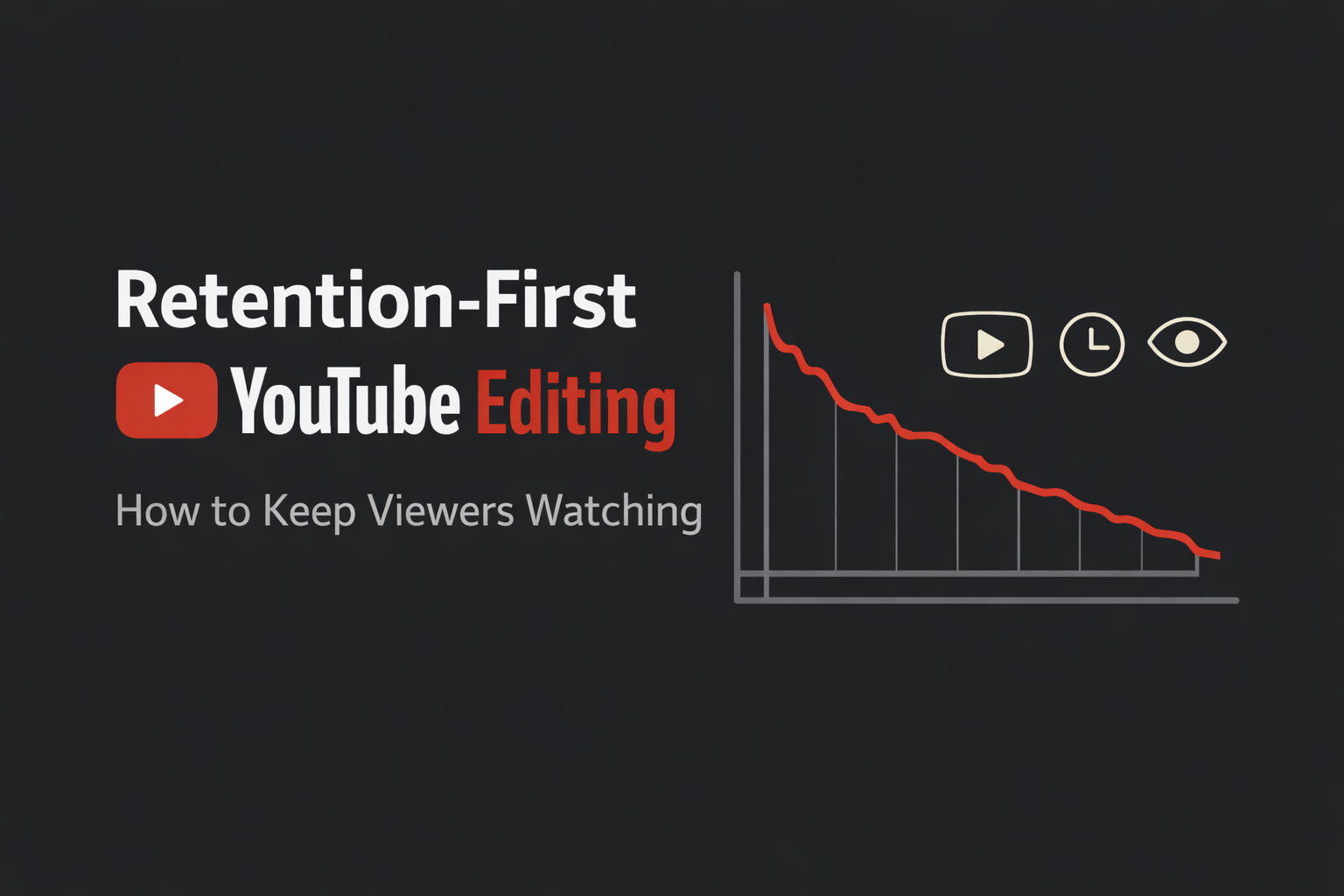
Most YouTube videos don’t fail because the topic is weak or the idea is boring. They fail because the editing gives viewers too many silent opportunities to leave. YouTube doesn’t evaluate effort or intention. It evaluates behavior. How long people stay, where they hesitate, and when they decide the video is no longer worth their attention.
Retention-first editing starts with an uncomfortable assumption: viewers are not committed to your video. They are constantly re-evaluating it. Editing, then, is not about polish or visual flair. It is about reducing the number of moments where exiting feels easier than staying.
This behavioral foundation is explained more deeply in The Psychology of Watch Time: how to design addictive videos, where attention is treated as a cognitive process rather than a creative one.
What Retention-First Editing Actually Optimizes
Traditional editing focuses on clarity, smoothness, and visual consistency. Retention-first editing focuses on attention continuity. Instead of asking whether a cut looks good, it asks whether the viewer is still mentally engaged after the cut.
At any moment in a video, a viewer is in one of four states: actively following, passively listening, drifting, or deciding to leave. Editing should continuously pull the viewer back toward active following. This is not achieved through speed or effects, but through alignment between information flow and how the brain processes it.
Principle 1: Match Pacing to Idea Difficulty
Pacing everything the same way is one of the most common causes of retention loss because it breaks the viewer’s cognitive rhythm. When simple ideas are stretched and complex ideas are rushed, the brain is forced into either boredom or overload, both of which accelerate disengagement. For example, explaining an obvious point across multiple sentences while compressing a nuanced concept into a single breath creates constant friction, even if the content itself is valuable.
This is why early pacing matters so much, a pattern we break down in The First 5 Seconds Rule on YouTube: why viewers click away, where even minor delays compound into early exits.
Principle 2: Edit at the Idea Level, Not the Sentence Level
Editing at the sentence level instead of the idea level weakens retention because viewers track progress conceptually, not grammatically. When an idea changes, attention resets, and if the visual structure remains unchanged, the brain senses movement without orientation. For instance, moving from a strategic concept to a tactical breakdown without changing framing, pacing, or visual context makes the transition feel unclear, even if the words themselves are well edited.
Structural signals don’t have to be verbal. They can be:
section transitions
framing or angle changes
visual examples replacing abstraction
pacing shifts that signal progression
When structure mirrors thought progression, viewers stay oriented instead of fatigued.
Principle 3: Dead Time Is More Dangerous Than Weak Information
Dead time is more dangerous than weak information because it removes the viewer’s reason to stay mentally engaged. Even flawed or debatable ideas can hold attention by giving the brain something to evaluate or push against, whereas dead time offers no mental task at all. For example, verbal hesitation, repeated phrasing, or an unintentional pause after an obvious statement signals that nothing important is happening, and that brief signal is often enough to trigger an exit.
Principle 4: Maintain Direction Throughout the Video
Lack of direction causes retention to drop because viewers need to feel guided, not just informed. When a video stops signaling what problem it is solving or how each section connects to the larger point, viewers begin questioning the value of continuing. For example, a video that jumps from insight to insight without clear structural cues may be informative, but it feels aimless, which quietly erodes retention.
Principle 5: Prioritize Clarity Over Cleverness
Prioritizing cleverness over clarity reduces retention because it increases cognitive strain. Viewers stay engaged when understanding feels effortless, not when they have to decode phrasing or mentally reconstruct meaning. For instance, avoiding reinforcement to sound original may feel sophisticated, but it often forces the viewer to pause and reinterpret, interrupting attention and increasing drop-off risk.
How to Apply Retention-First Editing Practically
Before publishing, review your video with attention in mind rather than aesthetics. Ask:
Where does the pacing feel comfortable instead of engaging?
Where does an idea change without a structural signal?
Where does nothing new happen for several seconds?
Where might a viewer wonder why they should keep watching?
Fixing just those moments often improves retention more than adding transitions, captions, or effects.