- Why Does the First Frame Matter So Much on TikTok and Reels?
- What Is a “First Frame” in Short-Form Video?
- How Does the Brain Process the First Frame?
- What Makes a High-Performing Opening Shot?
- 1. Immediate Motion
- 2. Strong Visual Contrast
- 3. Emotional Signal
- 4. Instant Context Clarity
- 5. Framing That Breaks Feed Patterns
- How Can You Optimize Your First Frame Practically?
- Pro Tip: Record the Opening Separately
- Action Plan: Upgrade Your Opening Shot This Week
The power of the first frame is not creative theory. It is measurable performance leverage.
On TikTok and Instagram Reels, your opening shot determines whether your content earns a second of attention or disappears into the scroll. Before your hook is fully processed, before your message lands, the brain has already classified your video as relevant or ignorable.
If you are serious about short-form growth, understanding why your opening shot matters is not optional. It is structural.
This article breaks down the psychology, algorithm mechanics, and tactical execution behind high-performing first frames, with practical examples you can apply immediately.
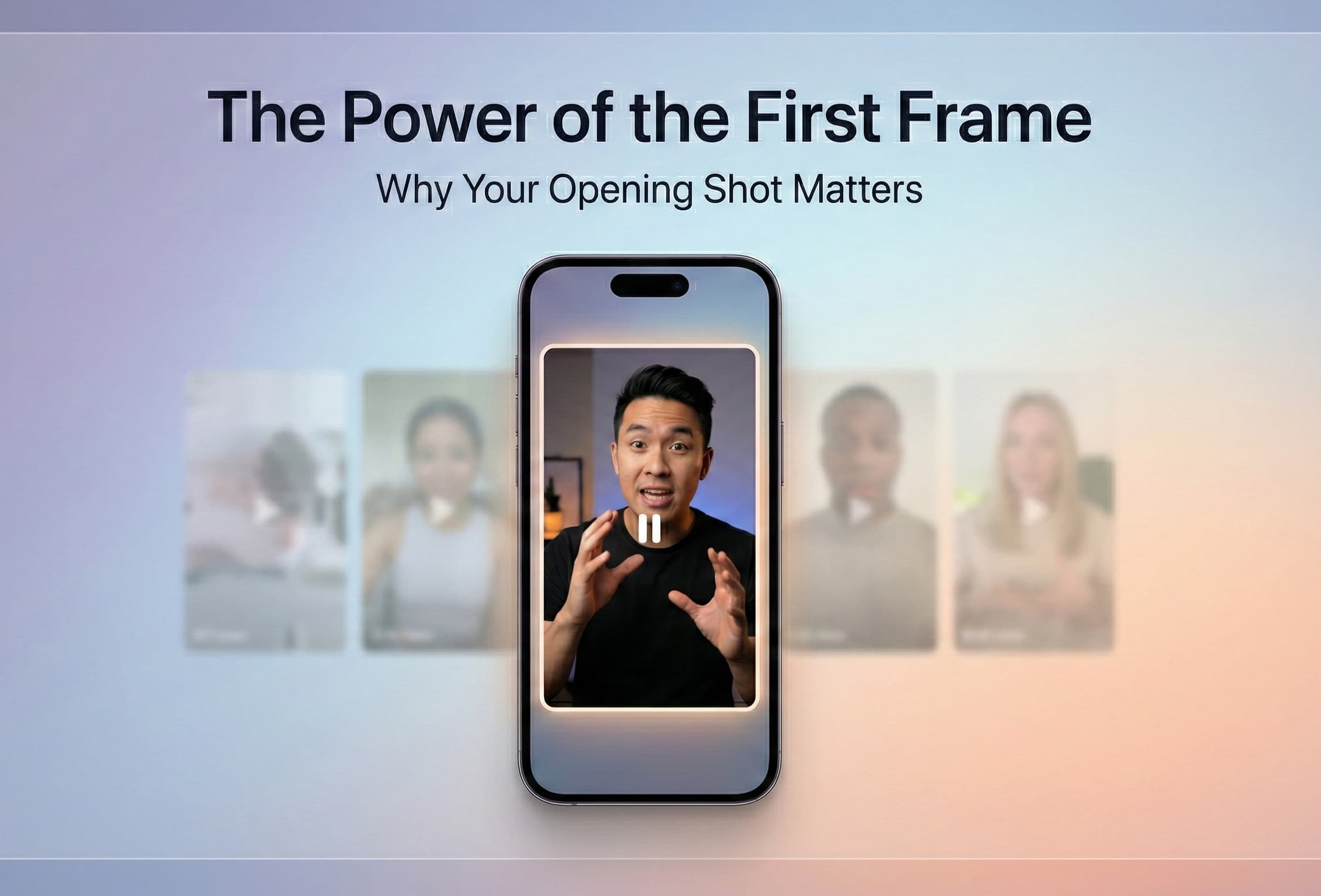
Why Does the First Frame Matter So Much on TikTok and Reels?
Short-form platforms prioritize early retention.
According to TikTok’s official explanation of its recommendation system (https://newsroom.tiktok.com/en-us/how-tiktok-recommends-videos-for-you), watch time and completion rate are core distribution signals. What is often overlooked is that early drop-off heavily influences those metrics.
If viewers scroll within the first second:
Completion rate collapses
Average watch time drops
Distribution testing narrows
Algorithmic confidence decreases
Your first frame influences all of this.
What Is a “First Frame” in Short-Form Video?
The first frame is the visual state of your video at the exact moment it appears in the feed.
It includes:
Your facial expression
Camera framing
Lighting and contrast
On-screen text
Motion or lack of motion
It is not your first sentence. It is the visual hook before the verbal hook.
Many creators optimize scripts but ignore visual sequencing. That gap explains why strong ideas often underperform.
If you have read The Scroll-Stopping Formula: how to make people STOP instantly, you already understand that attention begins visually, not verbally.
How Does the Brain Process the First Frame?
Human attention is rapid and pattern-driven.
When scrolling, the brain asks:
Is this relevant to me?
Is this new or different?
Is this visually clear?
Is this worth cognitive effort?
Research in visual hierarchy and cognitive processing, such as insights from Nielsen Norman Group on visual attention principles (https://www.nngroup.com/articles/visual-hierarchy-ux-definition/), shows that contrast, motion, and emotional cues are processed faster than language.
That means your first frame should communicate relevance before your voice does.
What Makes a High-Performing Opening Shot?
Below are five structural elements that increase early retention.
1. Immediate Motion
Static openings feel passive.
Subtle motion signals importance.
Examples:
Leaning into the frame
Hand mid-gesture
Text animating instantly
Object entering frame
The motion should feel natural, not chaotic.
2. Strong Visual Contrast
Contrast creates clarity.
High-performing first frames often include:
Bright subject against darker background
Tight framing instead of wide shots
Clear focal point with minimal background clutter
If your first frame blends into the feed visually, it will not earn pause time.
3. Emotional Signal
Emotion is processed faster than logic.
If you are discussing a mistake, your expression should show concern or intensity. If you are revealing insight, your expression should suggest discovery.
Neutral expressions rarely stop scroll momentum.
4. Instant Context Clarity
Confusion kills retention.
Within one second, the viewer should know:
What this is about
Why it matters
For example:
On-screen text:
“This is why your views stall.”
Visual:
Subtle declining graph behind you.
Now the viewer understands the topic immediately.
5. Framing That Breaks Feed Patterns
Most creators film centered, chest-level, neutral angle.
Micro-disruptions outperform loud gimmicks:
Slightly off-center framing
Closer crop
Eye-level intensity
Clean but distinct background
The goal is not shock. It is differentiation.
How Can You Optimize Your First Frame Practically?
Here is a simple audit framework.
Before posting, pause your video at frame one and ask:
Would I stop scrolling for this?
Is there visible motion?
Is the topic clear immediately?
Is my expression aligned with the message?
Is the framing distinctive enough?
If the answer is uncertain, adjust.
Sometimes improvement requires trimming 0.3 seconds. Other times it requires reframing the shot entirely.
Pro Tip: Record the Opening Separately
Many advanced creators record their first frame intentionally instead of relying on natural footage.
Film a deliberate opening sequence:
One strong gesture
One clear expression
One visual anchor
Then edit your spoken hook to begin immediately.
This approach separates creative performance from structural optimization.
Platforms like Reachism (https://reachism.com/) emphasize this systems-level thinking, where growth is engineered through repeatable frameworks rather than hoping each upload performs.
When the first frame becomes intentional, performance stabilizes.
Action Plan: Upgrade Your Opening Shot This Week
Analyze your last five videos and note early drop-off points.
Screenshot your first frame and compare it to top creators in your niche.
Add motion within the first half-second.
Add context text immediately.
Tighten framing and remove visual clutter.
Measure results over 10 uploads.
Retention improvement often appears quickly when first-frame design is intentional.