- What Makes a TikTok Hook “Work” Today
- Core TikTok Hook Formulas (With Plug‑and‑Play Scripts)
- 1. Bold Statement Hook
- 2. Question Hook
- 3. Pattern Interrupt Hook
- 4. Proof‑First Hook
- 5. “If You…, Stop Scrolling” Call‑Out
- 6. “This Is What Happens When…” Hook
- 7. List / “X Things” Hook
- Psychology Behind High‑Retention Hooks
- Step‑By‑Step: How to Build TikTok Hooks That Work
- Examples of Hook Success Stories
- Maximize Hook Effectiveness Using Reachism Tools
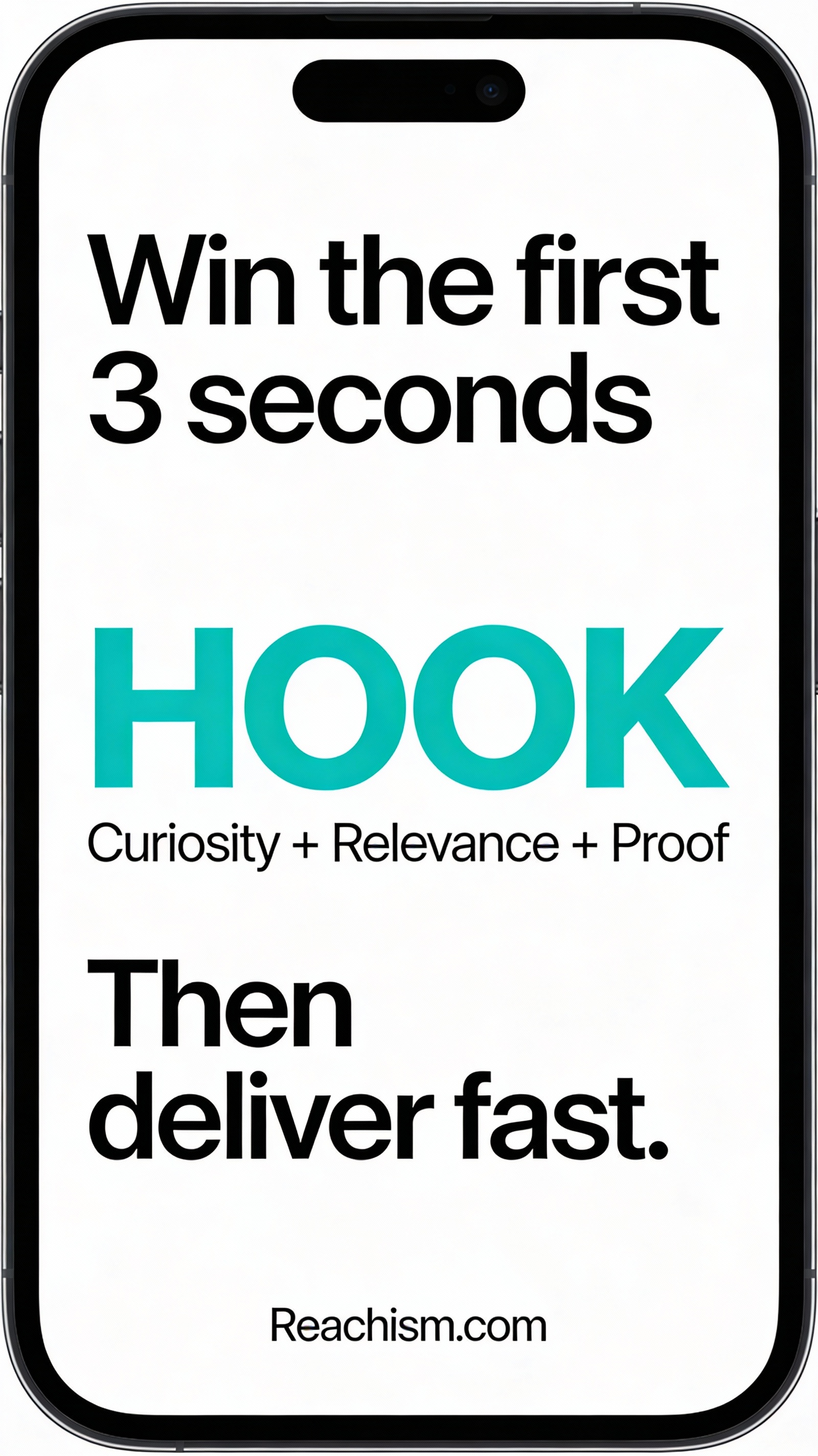
TikTok hooks that work in 2025 share one job: they must grab attention and hold it for at least three seconds, because that is the threshold where the TikTok algorithm starts rewarding your video with reach and impressions.
Structuring your hooks around curiosity, pattern interruption, and proof-based credibility is the fastest way to boost watch time, engagement, and conversions from both organic content and ads.
What Makes a TikTok Hook “Work” Today
A TikTok hook is the first 1–3 seconds of your video (visual and/or verbal) designed to stop the scroll and convince a stranger to give you their attention. Strong hooks are non‑negotiable because:
TikTok’s recommendation system heavily favors videos that hold viewers beyond the three‑second mark and into a high completion rate.
Videos with three‑second retention above roughly 65% can get 4–7x more impressions than clips that lose viewers immediately.
The majority of high‑CTR TikTok videos hook their audience within the first 3 seconds using sound, on‑screen text, or a striking action.
To build hooks that actually work, every opening needs to do at least one of these:
Interrupt the viewer’s pattern (something visually or sonically unexpected).
Create a curiosity gap (raise a question their brain wants answered).
Use social proof or proof‑first framing (show results or authority before explanation).
Core TikTok Hook Formulas (With Plug‑and‑Play Scripts)
Below are battle‑tested formulas you can adapt for any niche, from UGC and ecom brands to coaches and local businesses. Each formula includes why it works and example scripts you can use or tweak.
1. Bold Statement Hook
This hook opens with a specific, counterintuitive, or controversial claim that clashes with what viewers expect, creating cognitive dissonance that forces them to keep watching.
Why it works:
Challenges existing beliefs, making the brain pause to reconcile the claim.
Quickly positions you as someone with insider knowledge or a strong point of view.
Use it for: education, contrarian tips, myth‑busting, commentary.
Examples you can swipe:
“Most creators are killing their reach with their hooks, not their content.”
“You don’t have a content problem, you have a three‑second problem.”
“Ads that look like ads die in 2 seconds on TikTok."
“If you’re still starting videos with ‘Hey guys’, you’re losing 70% of your views.”
2. Question Hook
Here, you open with a question your exact audience desperately wants answered and that they cannot resolve with a simple yes/no.
Why it works:
Creates an information void that viewers feel compelled to close.
Speaks directly to pain, frustration, or desire instead of vague curiosity.
Use it for: tutorials, how‑to, strategy breakdowns, product education.
Examples:
“Why do some TikToks explode with 200 followers while others die at 20,000 views?”
“Why are your hooks getting views but not clicks or sales?”
“Have you heard of the 3‑second rule TikTok doesn’t want you to ignore?”
“Have you ever wondered why your ‘stop scrolling’ videos still don’t convert?”
3. Pattern Interrupt Hook
This approach uses a surprising visual, sound, or motion right away, before the viewer consciously decides to keep scrolling.
Why it works:
The brain is wired to notice anything that breaks the feed’s visual rhythm.
It captures attention even with sound off, which is critical on TikTok.
Use it for: product demos, storytelling, humor, lifestyle, B‑roll heavy content.
Ideas and scripts:
Start by putting your phone down, then leaning into frame as if sharing a secret.
Slide a product dramatically into frame in the very first second.
Start with a close‑up of something unusual (analytics spike, strange object, wild facial expression) then zoom out to context.
Begin mid‑action (cleaning, pouring a drink, blow‑drying hair) while you start talking.
4. Proof‑First Hook
You lead with a result, transformation, or credibility marker, then explain how you got there.
Why it works:
Establishes authority and trust before asking for attention.
Uses social proof to make the viewer think, “If they did that, I should listen.”
Use it for: case studies, growth stories, before/after, client results.
Examples:
“I grew this account from 0 to 50,000 followers in 90 days using one hook framework.”
“These 3 hooks cut our TikTok ad costs in half last week.”
“Clients using this script are seeing 3–5x more watch time on their TikToks.”
5. “If You…, Stop Scrolling” Call‑Out
A classic direct call‑out that names your audience and commands them to stop.
Why it works:
Hyper‑relevant targeting: people feel seen and addressed personally.
Clear instruction (“stop scrolling”) that primes them to stay.
Use it for: niche‑specific tips, offers, quick wins.
Examples:
“If you run TikTok ads for ecom brands, stop scrolling.”
“If you’re tired of posting Reels that cap at 300 views, stop scrolling.”
“If you create UGC but your videos die in the first 3 seconds, stop scrolling.”
6. “This Is What Happens When…” Hook
You tease the outcome of a choice, mistake, or action, triggering curiosity.
Why it works:
Implies a story arc and payoff (“this is what happens”) that viewers want to see.
Pairs perfectly with strong visuals (before/after, transformation, reveal).
Use it for: transformations, experiments, product demos, social proof.
Examples:
“THIS is what happens when you fix your TikTok hooks before your content.”
“This is what happens when you test 5 hook variations on the same video.”
“This is what happens when you stop saying ‘Hey guys’ and start with proof instead.”
7. List / “X Things” Hook
You promise a compact list of value‑packed points right away.
Why it works:
Gives structure and predictability; viewers know what they’re getting.
High perceived value in a short time frame.
Use it for: tips, frameworks, mistake breakdowns.
Examples:
“3 TikTok hooks that work in any niche.”
“5 hooks that took my videos from 2 seconds to 8 seconds average watch time.”
“7 openers that sell your product without sounding like an ad.”
Psychology Behind High‑Retention Hooks
Hooks that consistently perform are not random; they sit on a few psychological levers.
Key principles:
Pattern interruption
Anything that breaks the visual or audio pattern of the feed forces a micro‑pause.
Examples: sudden camera moves, surprising props, bold text overlays, unusual framing.
Curiosity gaps
Statements like “Most people think X, but here’s what actually works” immediately raise the question: “Am I wrong?”
Questions or teases where the payoff is clear but not yet revealed push viewers to stay.
Social proof and authority
Leading with visible results (analytics screenshots, before/after, follower jumps) builds instant trust.
Viewers are more willing to invest attention when they see proof others already found value.
Time‑bound promises
Explicitly promising a payoff within a short time window (“in the next 8 seconds…”) reassures viewers that you respect their attention.
When you combine at least two of these (for example, a surprising visual + proof‑first line), you dramatically increase the odds of surviving the three‑second drop‑off.
Step‑By‑Step: How to Build TikTok Hooks That Work
Use this process every time you script content to turn hooks into a repeatable system, not a guessing game.
Clarify one clear value proposition
Define exactly what the viewer gets: result, insight, or feeling in one sentence.
If you cannot summarize the value, the concept itself needs tightening before you worry about hooks.
Match the right hook formula to the content
Educational content → bold statement or question hooks.
Entertainment or storytelling → pattern interrupt plus teaser question.
Case studies and offers → proof‑first plus call‑out.
Draft 3–5 hook variations per video
Treat hooks as a separate creative step; never settle for the first version.
Mix formulas (e.g., proof‑first + bold claim: “I tripled our watch time without changing a single edit. Here’s what changed.”).
Design hooks for silent autoplay
Add bold, high‑contrast text that communicates the hook even on mute.
Watch the first 3 seconds with sound off; if someone can’t understand the promise, rewrite.
Analyze retention and iterate
In analytics, check where viewers drop off; losing more than ~35% in the first 3 seconds means the hook is weak.
Strong early retention but a sharp drop after 5–7 seconds means the hook was good but the content failed to deliver the promise.
Examples of Hook Success Stories
Micro-Tutorials: Short, actionable hacks starting with “Here’s how…” often go viral because viewers immediately understand the value.
Reaction Videos: Using shock or relatable expressions triggers curiosity and empathy simultaneously.
Transformation Stories: Before/after sequences showcase tangible results and satisfy the brain’s desire for closure.
Maximize Hook Effectiveness Using Reachism Tools
Reachism offers tools to boost early visibility for your TikTok content. By pairing strong hooks with initial distribution, you can ensure that your first critical seconds reach the right audience, generating authentic engagement faster.