- What a Caption Hook Really Does (And What It Doesn’t)
- The Hook–Value–Direction Framework
- High-Performing Hook Types (With Strategic Context)
- An Insight Most Articles Miss: Hooks Compete With Speed, Not Content
- Another Overlooked Insight: Hooks Signal Audience Fit to the Algorithm
- Common Hook Mistakes That Quietly Kill Reach
- How to Improve Hooks Without Guessing
- Final Takeaways
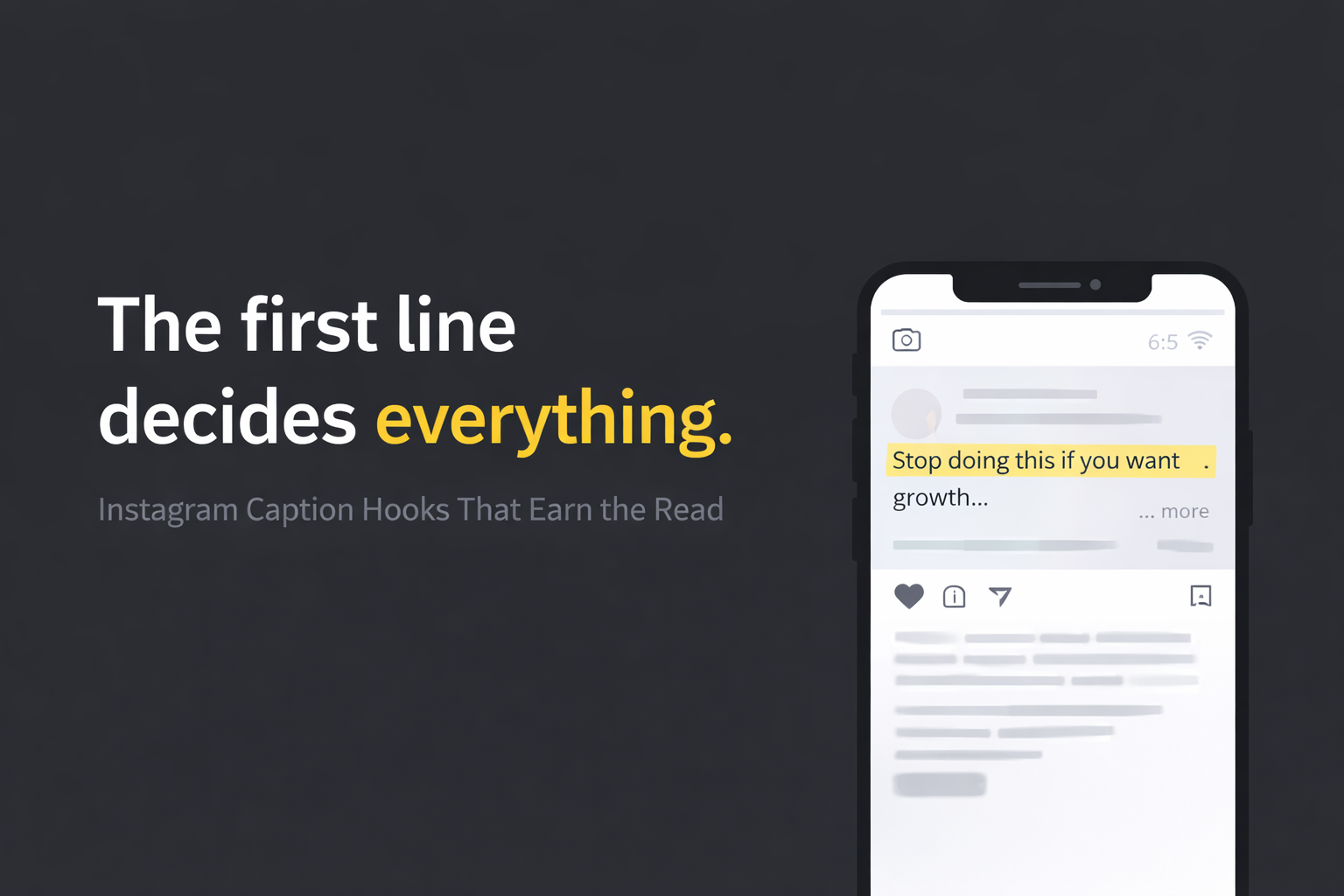
The hook is your opening move. If it’s weak, the rest of the caption is invisible no matter how smart, valuable, or well-written it is. This isn’t about writing prettier sentences. It’s about understanding how people decide whether something is worth their time while scrolling at speed.
What a Caption Hook Really Does (And What It Doesn’t)
A caption hook isn’t meant to explain your post. Its only job is to create momentum.
Specifically, a strong hook must trigger one decision:
“Is this worth a tap?”
Instagram’s interface forces this decision immediately. Before a user reads anything meaningful, they either:
tap “more,” or
keep scrolling.
That means your hook is not competing with other captions it’s competing with everything else in the feed.
This is the same attention battle described in The Scroll-Stopping Formula: how to make people STOP instantly, but applied at the caption level. Visuals stop the scroll. Hooks decide whether the stop turns into engagement.
The Hook–Value–Direction Framework
Most creators understand hooks. Fewer understand sequencing.
High-performing captions follow a simple but strict structure:
Hook → Value → Direction
Why this matters: asking for engagement before delivering value creates friction. Direction works because it feels earned.
Stage | What It Must Do | Why Most Fail |
|---|---|---|
Hook | Earn curiosity | Tries to be clever instead of relevant |
Value | Reward the tap | Repeats obvious advice |
Direction | Guide behavior | Pushes engagement too early |
Example (clean and effective):
Hook: “Your captions aren’t being ignored they’re being skipped.”
Value: Explain feed velocity, cognitive overload, and weak opening lines.
Direction: “Save this before your next post.”
This works because the reader already agrees by the time they reach the direction.
High-Performing Hook Types (With Strategic Context)
Curiosity Hooks (Precision Beats Mystery)
Curiosity works best when it’s specific, not vague.
“This is why your captions lose readers after line one.”
“Most creators misunderstand how the caption cutoff works.”
They outperform generic curiosity because they signal useful insight, not empty intrigue.
Problem–Solution Hooks (Reframing > Fixing)
Strong problem hooks don’t just identify pain they reframe it.
“Your captions aren’t too long. They’re just starting wrong.”
“You don’t need better writing just a better first line.”
This style positions you as someone who sees the problem differently, which is a quiet authority signal.
Relatability Hooks (Recognition Over Motivation)
Relatable hooks work because people don’t scroll to be inspired they scroll to feel understood.
“Ever write a caption you know is good and nobody reads it?”
“Posting consistently but engagement feels frozen?”
This principle mirrors what works in Instagram Story Psychology: how to keep people watching: recognition keeps people present longer than motivation ever will.
Contrarian Hooks (Authority, Not Attention)
Contrarian hooks are powerful and risky.
“Great captions don’t need emojis.”
“Short captions often outperform long ones.”
They only work if the following value proves the claim. Otherwise, they damage trust fast. Use them to challenge assumptions, not to chase reactions.
An Insight Most Articles Miss: Hooks Compete With Speed, Not Content
Here’s what rarely gets discussed:
Your hook is not competing with bad content. It’s competing with fast content.
People scroll because it’s easy. Your hook has to feel easier to read than it is to scroll past.
That’s why:
short lines outperform dense ones
clear language beats clever language
familiar problems beat novel ideas
Another Overlooked Insight: Hooks Signal Audience Fit to the Algorithm
Instagram doesn’t just track whether people engage it tracks who engages.
A clear, specific hook repels the wrong audience and attracts the right one. That improves downstream signals like saves, profile taps, and follows.
Common Hook Mistakes That Quietly Kill Reach
Neutral openers
“Let’s talk about captions.”
Nobody needs to.Information overload before the cutoff
Hooks aren’t summaries. They’re invitations.Mismatch between hook and value
A strong hook with weak delivery trains people to ignore you next time.
Instagram remembers fast exits.
How to Improve Hooks Without Guessing
Forget vanity metrics. Focus on signals tied to reading.
What to watch:
Saves per impression
Comments referencing the caption (not the video)
Profile taps after posts with long captions
If people comment on what you wrote, your hook did its job.
Final Takeaways
If you want captions that actually get read:
Write hooks for relevance, not creativity
Earn the “save” before asking for it
Match hook style to audience awareness
Treat hooks as filters, not bait
Optimize the first line before rewriting the whole caption