- What a “Content Gap” Really Means on YouTube
- Why Content Gaps Explode Faster Than “Good Ideas”
- Step One: Identifying High-Intent Viewer Questions
- Step Two: Diagnosing the Gap (Not Just Spotting It)
- Step Three: Designing the “Gap-Filling” Video
- Why Small Channels Win With the Content Gap Method
- Common Mistakes That Kill the Content Gap Advantage
- Conclusion
Most YouTube creators don’t fail because their videos are bad.
They fail because they’re answering questions that no one urgently wants answered or questions that have already been answered too well.
The fastest-growing YouTube channels don’t win by uploading more.
They win by finding content gaps topics people are actively searching for but aren’t being served properly.
This is the YouTube Content Gap Method.
What a “Content Gap” Really Means on YouTube
A content gap is not an untapped niche.
It’s a mismatch between:
What viewers are searching for or clicking on
And what existing videos are actually delivering
A gap exists when:
Titles promise answers but videos underdeliver
Old videos rank but feel outdated
High-interest topics exist with low-quality explanations
Search intent is clear but content clarity is missing
When you fill that gap, YouTube doesn’t just test your video it keeps pushing it, because viewer satisfaction spikes.
Why Content Gaps Explode Faster Than “Good Ideas”
Most creators brainstorm ideas. Gap-based creators reverse-engineer demand. YouTube’s algorithm is reactive. It doesn’t look for creativity it looks for better answers.
When your video:
Gets clicked more than expected
Holds attention longer than competing videos
Solves the problem more clearly
YouTube expands distribution aggressively, even if your channel is small. This is why newer channels can outrank established ones.
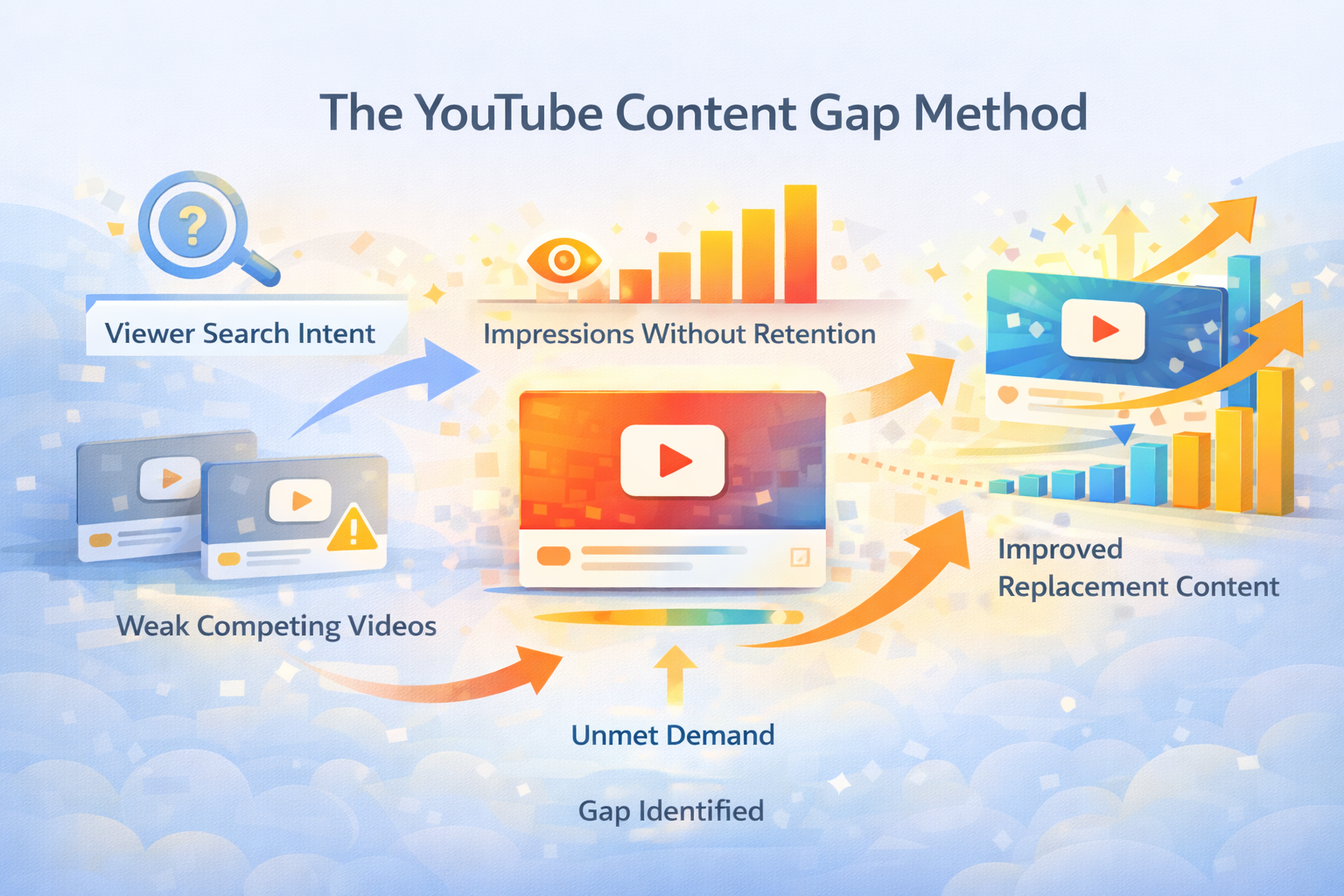
Step One: Identifying High-Intent Viewer Questions
The content gap method starts with viewer intent, not trends. You’re looking for questions where:
Viewers are frustrated
Answers are incomplete
Search volume is steady (not viral spikes)
Places to find these signals:
YouTube autocomplete
Comment sections under top videos
“People also watched” suggestions
Search results with old or low-retention videos
If a video ranks but has:
Weak thumbnails
Rambling intros
Poor explanations
Step Two: Diagnosing the Gap (Not Just Spotting It)
Not every weak video is a gap. A real gap usually shows one of these failures:
The video answers what but not why
The explanation is too advanced for beginners
The title promises speed, but the video is slow
The topic changed, but the video didn’t
This is where most creators stop too early. They copy the topic instead of fixing the failure. Your job is not to create another version. Your job is to create the version the viewer wishes existed.
Step Three: Designing the “Gap-Filling” Video
Once the gap is clear, the video must be built differently, not just better.
Gap-filling videos share three traits:
Immediate clarity
The viewer understands in the first 5 seconds why this video is different.Faster payoff
The answer starts early, not after context.Structured explanation
The viewer feels guided, not talked at.
This is why gap videos often feel “simple” but outperform complex content.
- https://reachism.com/blog/breaking-down-the-perfect-youtube-script-structure
Why Small Channels Win With the Content Gap Method
Large channels are optimized for breadth. Small channels can optimize for precision.
When you publish a video that:
Solves a known frustration
Matches search intent perfectly
Delivers higher satisfaction
YouTube doesn’t care about subscriber count it cares about outcomes.
This is why content gaps are one of the most reliable growth paths for small channels.
- https://reachism.com/blog/youtube-monetization-secrets-how-small-channels-earn-big
Common Mistakes That Kill the Content Gap Advantage
Creators sabotage gap opportunities when they:
Chase trends instead of intent
Overproduce instead of over-clarify
Copy titles without fixing structure
Add opinions where viewers want answers
A content gap is fragile.
If you don’t respect the viewer’s need, YouTube closes it fast.
- https://reachism.com/blog/the-anti-trend-strategy-growing-fast-without-chasing-trends
Conclusion
You don’t need new ideas. You need better answers to existing questions.
The YouTube Content Gap Method works because it aligns:
Viewer frustration
Algorithmic incentives
Creator leverage
When you stop guessing and start diagnosing gaps with the help of real performance signals growth becomes predictable.