- What Are TikTok Dead Zones?
- Dead Zone 1: Posting at Low-Intent Times (Not Just “Off Hours”)
- Dead Zone 2: Saturated Topics With No Differentiation
- Dead Zone 3: Content That Takes Too Long to Signal Value
- Dead Zone 4: Posting Inconsistently After a High-Performing Video
- Dead Zone 5: Comment-Bait Without Retention
- Dead Zone 6: Repeating the Same Hook Style Too Often
- Dead Zone #7: Educational Content Without Emotional Friction
- How Reachism Avoids TikTok Dead Zones
- Final Thought: TikTok Isn’t Random It’s Reactive
TikTok doesn’t suppress creators randomly. Most reach drops happen for predictable reasons specific posting times, content formats, and topic choices that quietly push your video into what we call TikTok’s dead zones.
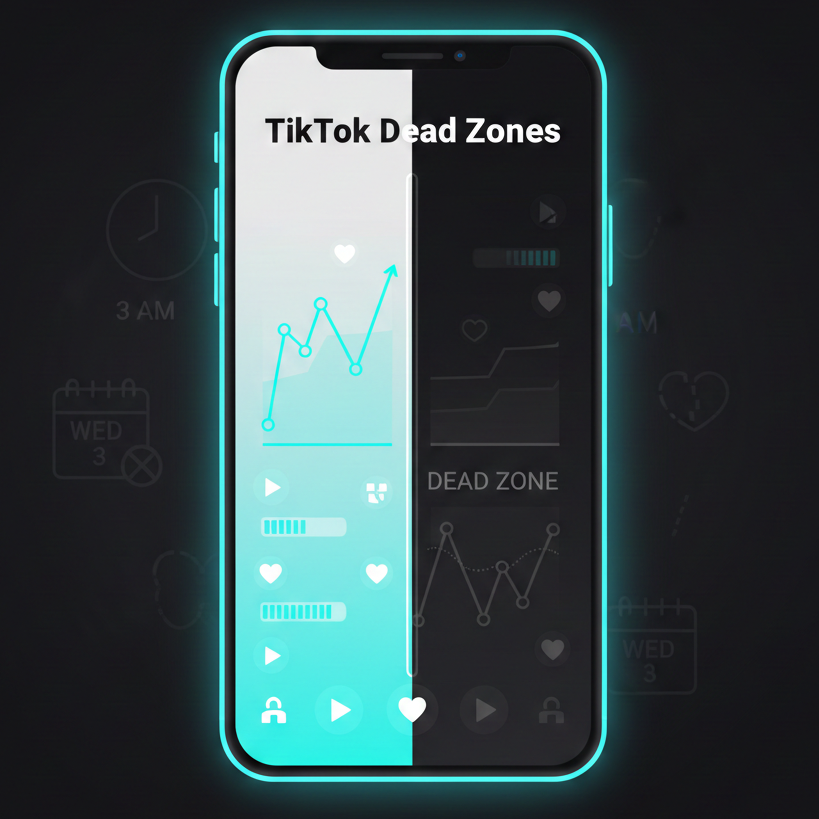
What Are TikTok Dead Zones?
A TikTok dead zone is any combination of timing, topic, or content behavior that signals low distribution potential to the algorithm.
Dead zones are not about:
Shadowbans
Luck
Hashtags
They’re about algorithm confidence.
When TikTok doesn’t see fast, clear audience signals, it stops pushing your video—often within the first 30–90 minutes.
This aligns directly with why most TikTok videos fail early
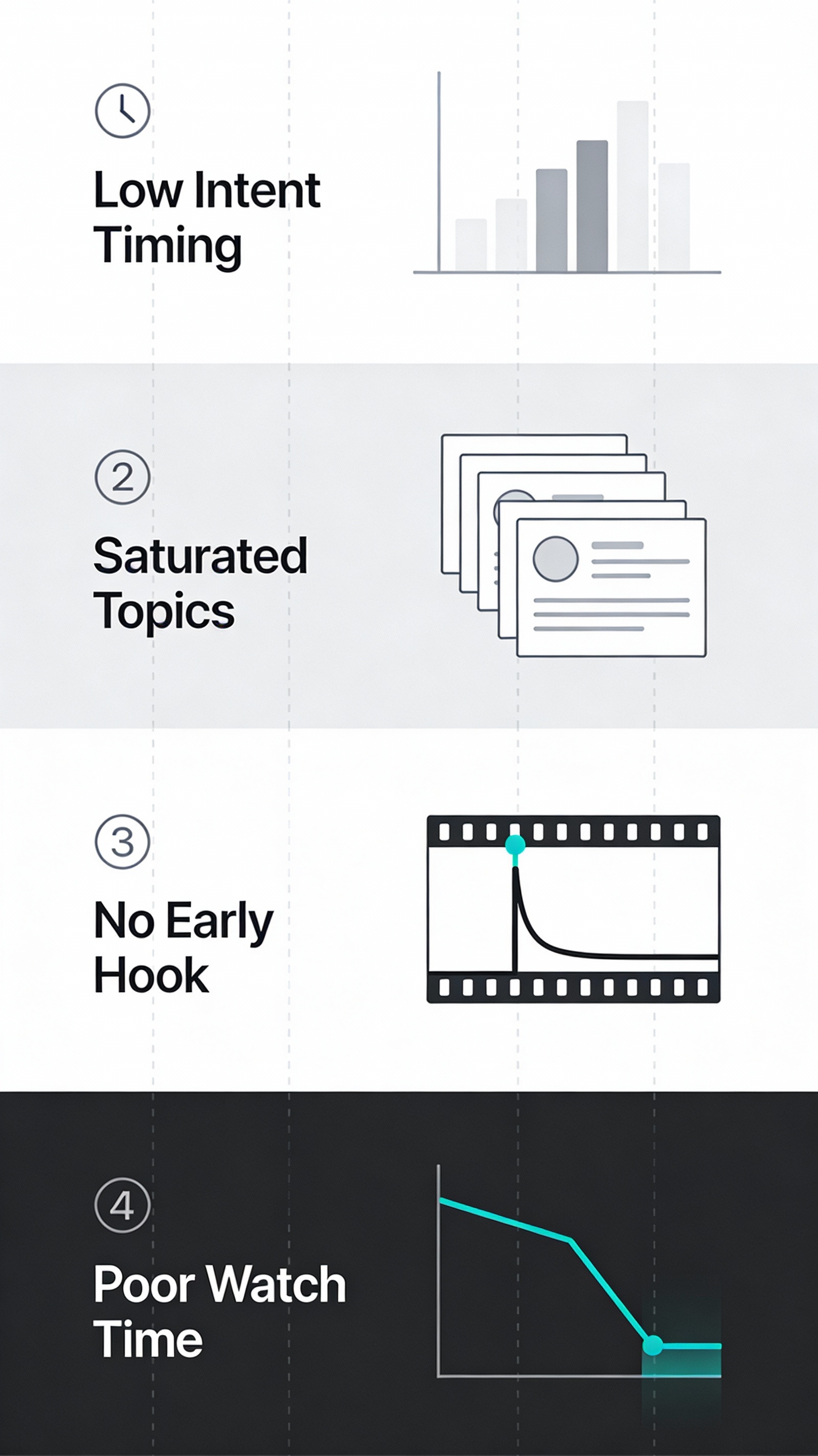
Dead Zone 1: Posting at Low-Intent Times (Not Just “Off Hours”)
The biggest myth is that dead zones are about time zones.
They’re actually about viewer intent density.
True Low-Intent Windows
These are periods when users scroll passively, not interactively:
Very early mornings (5–7 AM local)
Late nights after 11:30 PM
Midday work/school hours (12–2 PM weekdays)
During these times:
Watch time drops
Rewatches decline
Saves and shares are rare
TikTok interprets this as content quality failure, not timing failure.
High-Intent Windows (Algorithm-Friendly)
7–9 AM (routine scrolling)
6–9 PM (relaxed, intentional viewing)
Weekend mornings and evenings
The algorithm doesn’t reward posts when people scroll—it rewards posts when people pause.
Dead Zone 2: Saturated Topics With No Differentiation
TikTok doesn’t hate popular topics.
It hates undifferentiated content.
Topics That Kill Reach Without a Twist
“Day in my life” (generic routines)
Motivational quotes without narrative
Surface-level AI tips
Trending sounds with no value layer
Reposted viral formats with no contextual angle
If TikTok has already seen your idea 1,000 times that day, your version must outperform immediately or it dies.
This is why creators who go smaller often grow faster. The Micro-Niche Strategy: Grow Faster by Going Smaller
Dead Zone 3: Content That Takes Too Long to Signal Value
TikTok decides distribution before your video ends.
If your value isn’t clear in the first 1–3 seconds, the system assumes:
Low relevance
Weak audience match
Poor retention potential
This is why some videos with great information still fail they explain instead of signal.
Dead Zone 4: Posting Inconsistently After a High-Performing Video
One of the most overlooked dead zones is momentum collapse.
When a video performs well, TikTok:
Expands your audience pool
Tests adjacent viewers
Increases profile curiosity
If you disappear for days after:
Momentum resets
Audience mapping weakens
Your next post starts cold again
Consistency isn’t about volume it’s about algorithm continuity.
Dead Zone 5: Comment-Bait Without Retention
Comment bait used to work.
Now it’s a reach killer if retention doesn’t support it.
Examples:
“Wait till the end” with no payoff
“Comment YES” with no reason to watch
Fake controversy without substance
TikTok tracks:
Comment-to-watch-time ratio
Completion rate after interaction
Rewatch behavior post-comment
If comments spike but watch time doesn’t, distribution shrinks.
Dead Zone 6: Repeating the Same Hook Style Too Often
Even good hooks decay.
TikTok detects:
Hook fatigue
Viewer familiarity
Reduced curiosity signals
This is why creators feel like they “suddenly stopped growing” even though nothing changed.
Rotating hook psychology is critical.
TikTok Hooks That Work
Dead Zone #7: Educational Content Without Emotional Friction
Pure information rarely spreads.
TikTok favors:
Pattern breaks
Emotional contrast
Cognitive tension
Instead of:
“Here’s how the TikTok algorithm works”
Use:
“TikTok won’t push your video if you do this in the first 3 seconds”
Education needs friction to travel.
This aligns with TikTok’s own stated priority on watch time and re-engagement signals.
https://www.tiktok.com/creators/creator-portal/en-us/
How Reachism Avoids TikTok Dead Zones
At Reachism, we don’t chase trends we engineer distribution-friendly content systems.
Our approach focuses on:
High-intent posting windows
Micro-topic dominance
Value density per second
Algorithm-aligned consistency
Retention-first scripting
Instead of asking:
“Why didn’t this video go viral?”
We ask:
“What signal failed—and when?”
That shift alone changes results.
Final Thought: TikTok Isn’t Random It’s Reactive
Every drop in reach has a cause.
Every dead zone sends a signal.
When you understand when not to post and what not to post, growth becomes predictable not frustrating.
If you want to build content that survives TikTok’s dead zones and compounds reach over time, study the system not the symptoms.
That’s how real growth happens.