- The Core Shift: From Views to Viewer Satisfaction
- What Actually Happens When You Upload a Video
- What Changed: Signals That Matter More Now
- Script Structure Is Now an Algorithm Lever
- Why Session Time Beats Video Time
- How to Adapt Your Channel to the New Algorithm
- Final Takeaway: YouTube Is a Satisfaction Engine
YouTube is no longer a platform where “good content eventually wins.” Today, videos are tested, filtered, and scaled aggressively often within hours. Many creators fail not because their content is bad, but because they misunderstand what the YouTube algorithm actually measures now.
This article breaks down the modern YouTube algorithm blueprint, what has fundamentally changed, and which signals truly matter if you want consistent views, longer watch time, and sustainable channel growth.
This is not a list of hacks. It’s a system-level explanation designed for creators, brands, and teams who want predictable results.
The Core Shift: From Views to Viewer Satisfaction
The biggest change in YouTube’s algorithm is priority.
YouTube no longer optimizes for:
Raw views
Clicks alone
Upload frequency
Instead, it optimizes for viewer satisfaction over time.
That includes:
How long people watch
Whether they keep watching other videos
If the viewer feels the click was “worth it”
This is why creators who understand Audience Signals: how YouTube decides who to push your video to consistently outperform those chasing trends.
YouTube’s goal is simple: keep users on the platform longer happily.
What Actually Happens When You Upload a Video
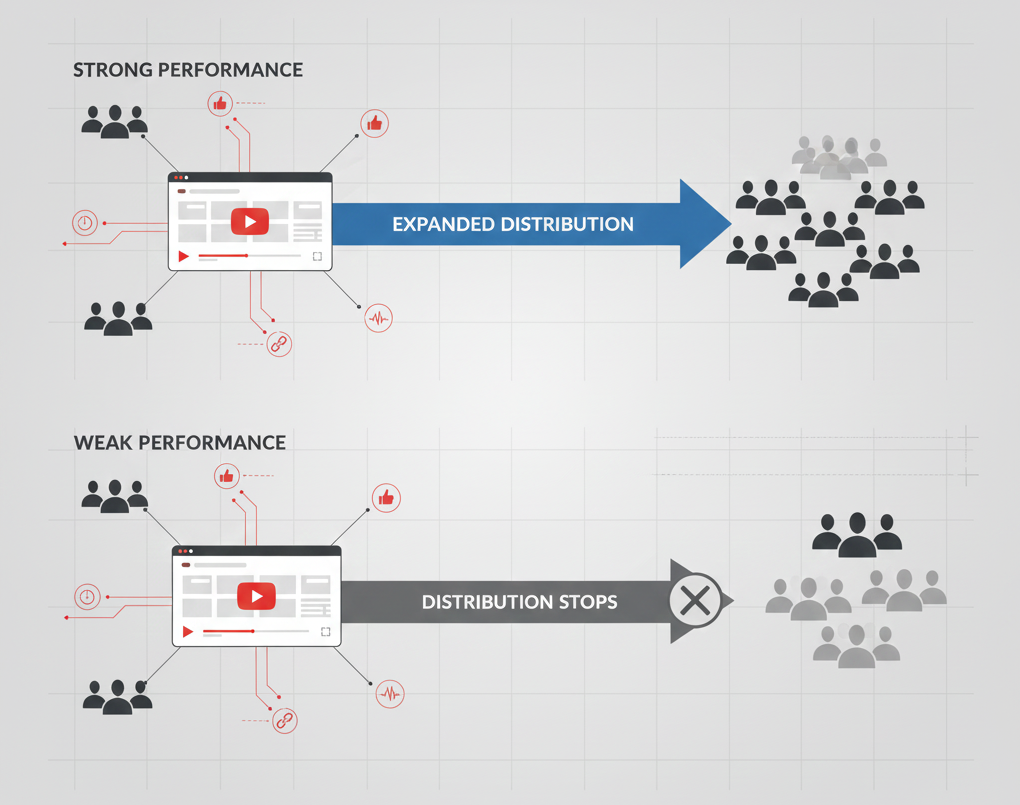
When a video is published, YouTube runs it through a testing phase.
Phase 1: Small Audience Sampling
Your video is shown to:
A portion of your subscribers
Viewers with similar watch history
YouTube measures:
Click-through rate (CTR)
First 30–60 seconds retention
Session continuation
If early signals are weak, distribution slows.
This explains Why Most Videos Die Early, not because they’re bad but because early signals fail.
Phase 2: Retention & Session Impact
If viewers stay, YouTube expands reach.
At this stage, the algorithm watches:
Average view duration
Rewatches
Whether viewers click another video after
This ties directly to The Psychology of Watch Time: how to design addictive videos.
Retention is no longer a metric it’s the gatekeeper.
What Changed: Signals That Matter More Now
1. The First 5 Seconds Matter More Than Ever
YouTube aggressively measures early abandonment.
If viewers click away instantly, the system flags the video as misaligned regardless of total length.
This is why The First 5 Seconds Rule on YouTube: why viewers click away is now non-negotiable.
Strong openings:
Confirm the title promise
Eliminate slow intros
Set expectation immediately
2. Titles & Thumbnails Are Judged Together
CTR alone is no longer enough.
YouTube now cross-checks:
Title promise
Thumbnail expectation
Actual viewing behavior
If viewers click but leave early, reach collapses.
That’s why How to Craft Titles & Thumbnails That Print Views focuses on alignment not clickbait.
3. Viewer History Shapes Distribution
Your video is not shown to “everyone.”
It’s shown to:
People who watched similar topics
Viewers who stayed on related content
This means topic consistency matters more than virality.
Channels that jump topics confuse the algorithm and stall growth.
Script Structure Is Now an Algorithm Lever
Modern YouTube rewards designed viewing experiences.
High-performing videos follow intentional structure:
Immediate hook
Clear promise
Open loops
Pattern interruptions
Satisfying payoff
This is why Breaking Down the Perfect YouTube Script Structure is now a growth skill, not a creative preference.
Poor structure kills retention even with great ideas.
Why Session Time Beats Video Time
YouTube doesn’t just ask:
“Did they watch your video?”
It asks:
“Did they keep watching YouTube?”
Videos that lead viewers into:
Another video on your channel
Or similar content elsewhere
get rewarded.
This is where Audience Signals and watch-path design separate professionals from amateurs.
How to Adapt Your Channel to the New Algorithm
1. Narrow Your Topic Focus
Channels grow faster when YouTube knows:
Who your content is for
What problem you solve
This mirrors the Micro-Niche Strategy: growing faster by going smaller, applied to long-form video.
2. Design for Retention First
Before recording, ask:
Where might viewers leave?
What keeps them watching?
Retention planning matters more than production quality.
3. Build Internal Viewing Loops
Use:
End-screen alignment
Topic continuity
Series-based formats
This increases session value a major ranking factor.
Final Takeaway: YouTube Is a Satisfaction Engine
The YouTube algorithm didn’t become harder it became clearer.
It rewards creators who:
Respect the viewer’s time
Deliver on promises
Design content intentionally
If you stop chasing tricks and start optimizing for viewer experience, growth becomes systematic.
That’s the real YouTube algorithm blueprint and it’s working exactly as designed.